Field of Science

Point-light walkers

By far the best point-light walker demonstration I've seen is at biomotiolab.ca. I'm classifying this as an illusion (see post label) because, of course, point-light walkers aren't really walking people -- they are just a few white dots moving around the screen. Comparing the male and female versions is particularly fun if you've ever wondered what exactly it is that makes for a stereotypical male or female stride.

It also appears that there is an experiment you can participate in if you want to help with this kind of research.


Fair Use & FedEx


And now for something completely different:One private citizen's trials and travails trying to convince FedEx to print posters.

I have wanted a map of Hong Kong on my wall for some time. The Survey & Mapping office of the Hong Kong government helpfully provides some free maps for public use on their website. You will notice how the website helpfully includes a "free maps"logo, along with a copyright notice forbidding only commercial use of the map. Presumably they thought this was a good way of providing some publicity for the Special Administrative District.

They did not take into account FedEx Office. I put this map on a USB stick and went to the FedEx Office at Government Center to have it printed. The manager there refused to print it as I didn't have proof of copyright ownership. I showed him the website (particularly where it says "free maps"). He said the fact that the map is free for public use was irrelevant; he needed a signed document from the copyright owner (the government of Hong Kong) stating that I, personally, had the right to print off the map.

His explanation for his refusal was simple: "I can't get between me and the copyright holder." I pointed out that he was getting between me -- who wants to print the map -- and the copyright owner -- who also wants me to print the map. He repeated that even so, he "can't get between me and the copyright holder." This was just repetition, so I pointed out again that the map is clearly labeled for public use. He said that was just "he said/she said" business; what he needed was a signed document.

I'm curious what he would do with a signed document in Chinese, and whether he would require a notarized translation. I realized as I was leaving that at the beginning when the manager was trying to establish whether I had the right to print the map, he had asked me if I was a member of the organization that made the map -- that is the Hong Kong government. I'm curious what would have happened if I had said yes.

The "copyright waiver"


This is not the 1st time that I've had a run-in with the copyright police at FedEx. Last year the Palo Alto FedEx refused to print a poster that I was supposed to present at a conference at Stanford. I study story comprehension in small children, and a common practice is to use stories about familiar characters. In this case, I had stories about Dora the Explorer and a few other cartoon characters. Because my poster showed an example of one of the pictures that we had drawn to go with the stories, FedEx initially refused to print the poster, saying that it violated copyright.

After a long discussion about fair use and noncommercial uses, one of the employees remembered that they have a “copyright release” form that they can use in these circumstances. Unfortunately, they couldn't find any blank copies. One enterprising employee simply wrote the words “copyright release” on a piece of paper and asked me to sign that piece of paper.

I wasn't sure about the wisdom of signing and essentially blank piece of paper (you can see a photo of it on the right), so they came up with another plan, which was to whiteout all the writing on a previously filled out form, which they then copied (not waiting for the whiteout to dry and getting white out all over their copier in the process) and which I signed. Then they printed my poster and I went on to have an otherwise successful conference.

Copyright and FedEx

Clearly somebody has instilled the Fear of the Lord into the  employees at FedEx with regards to copyright infringement. FedEx is understandably concerned about their liability, since unlike me, they have actual assets. I also realize that FedEx may not have the resources to have somebody on staff who has been adequately trained to deal with copyright issues ... but in that case, it suggests that maybe they do not have the resources to run a print shop. After all, it is not like they are not making determinations now. They are just doing it randomly and incorrectly.

Are you a Red Sox or Yankees fan?

If so, a colleague has a short survey for you. It seems she is trying to get together as much data as possible for a talk next week. Apparently there is also an opportunity to win a $50 gift card, though my motivation for participating was in order to help out with some interesting research.

Zeno

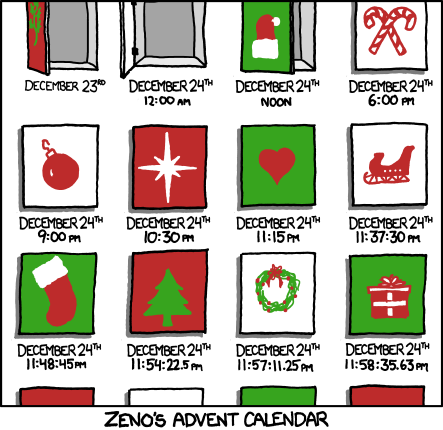
Many people are familiar with Zeno's paradox, though probably not in the form presented by XKCD:

(If you aren't familiar with it or need a refresher, just follow the link above.)

Perhaps this is widely known, but I only recently discovered what the point of Zeno's paradox was: he was trying to prove that motion is impossible. Nothing ever moves and nothing ever changes.

This probably sounds absurd, but it was the basis of a philosophical school of which Zeno was part. Zeno created a number of paradoxes, all of which were meant to demonstrate that if the idea that nothing ever moves or changes is absurd, well then it is no more absurd than the idea that things do move and do change. If motion was possible, you would end up, for instance, with Zeno's never-ending race.

This is just another demonstration that many famous philosophical ideas are often remembered now for reasons very different from the reason for which they were first put forth.

(Insight gleaned from Anthony Gottlieb's excellent The Dream of Reason).

Color illusion -- too cool to believe

By far the most striking visual illusion I've ever seen. A little bit of color after-effect turns a black-and-white photograph into a vivid color photograph. You may have to do it a few times to convince yourself it is real.

Results: Replication in Psychology


My paper with Adena Schachner on replication in psychology is now published. The paper contains 3 main sections: a reasonably thorough literature review on replication rates in psychology, a proposal as to how to improve replication rates (primarily through tracking replication rates), and the results of a survey of psychologists on replication practices (many thanks to all who participated). The results of the survey was that while not nearly enough replications are attempted, there are actually more being attempted than we had guessed (or than many of our colleagues that we discussed this project with had guessed).
This paper is part of a larger collection of papers on reimagining the publication and review process, and is more of those papers are printed, I plan to discuss at least some of them.

Pilot data

I am back from a long semi-silence.I have been trying to finish up a number of projects, which gives me less time to write. Speaking of…

One of the focuses of my work is figuring out how children learn the meaning of verbs. This is made more complicated by the fact that we don't actually have completely solid and uncontroversial definitions of verbs. If we don't know what verbs mean, how can we tell when a child has successfully learned them?

I am working on a large scale project to get better definitions of verbs. We are developing many different tasks, each of which gets at one specific aspect of meaning that is thought to be important for at least some verbs. The traditional method would be to have skilled linguists go through verbs one at a time and consult their own intuitions, and in fact a lot of very good work has been done this way (e.g., Jackendoff's Semantic Structures, among many others). However, there are certain advantages to having this work done by a larger number of people who are naïve to linguistic theory, not the least of which is that there are a very large number of verbs, and one person can't get through them all in any reasonable speed. The one disadvantage of working with naïve participants is that they do not understand linguistic 
terminology, so you have to find some other way to explain the task.

I have been developing some such tasks, and I could really use some pilot data to see how well they are working. If you have a little time to spare, I would really appreciate the help. There are 3 in particular I am currently working on:


There is a comments box at the end where you can leave any feedback and mention anything you noticed or which you found confusing. I do need data on all three, so please don't everyone just do the first one. 

Fair warning: These tasks take a bit longer than the ones on my website. My guess is that they will take 20-30 minutes each, but that is a wild guess. If somebody does one and wants to leave a comment about how long it took, that would be helpful for me and also for others who might want to do it.

Many thanks.

Someday we will hopefully have good dictation software. For now, there is Dragon Dictate

Mary Grover at Salon has distilled the essence of using Dragon Dictate into a brief post. I couldn't possibly do better -- or even as well -- so I refer you to it.

I was assured by several people that if I continued to use DragonDictate and use the vocabulary training feature, eventually the software would learn to do a better job. I made sure to diligently train Dragon on everything that I wrote. Unfortunately, it appears that training function itself is broken. I was suspicious that even when I used very unusual words, it always insisted that it already knew all those words. So I tested it by training on a set of made-up words. When Dragon happily announced that it already knew all of those words, too, I wrote an e-mail to technical support.
I wasn't very optimistic about hearing from technical support, since they had not replied to my previous e-mails when I have had other questions. This time, they replied promptly to tell me the technical support had expired, but that I could pay for extended technical support. Presumably, if I were to pay, they would go back to not answering e-mails.
I spend a lot of time at the computer, and I bought Dragon so that I wouldn't have to spend all of that time typing. I pace when I think, but pacing and typing don't mix. I thought Dragon would give me more flexibility. As of yet, this remains a distant dream.

More on DragonDictate

DragonDictate continues to do a decent job of writing my email, so long as I don't talk about work. For writing papers, etc., it continues to be of limited use.

I was just dictating notes on how children learn to count. In two back-to-back sentences, I mentioned "subset-knowers". The first time, this was transcribed as "subset-members", and the second time, it was "sunset-whores".


DragonDictate

 I have been doing a great deal of writing lately, though obviously not here. I thought that perhaps at some point in graduate school, I should try getting some of the projects I have done published, and I thought that time was now. Since this requires writing them up, I have been writing. I have gotten a lot of writing done, but I noticed that this came with an increased number of hours spent sitting at my computer. Knowing enough  friends who have suffered from repetitive stress injuries, I decided I should take a proactive approach to ergonomics.

One outcome of this process is was that I purchased voice-recognition software, namely Dragon Dictate. This actually complements my preference to pace while I think. My writing style involves a lot of thinking, punctuated by occasional bursts of typing. So being able to write as I pace seemed like a good idea.

I cannot say that this experiment has been an overwhelming success. Based on what I have learned from the documentation, Dragon Dictate seems to place a great deal of faith in transitional probabilities. That is,  the hypotheses it makes about what you are saying are based not only on the sounds that you make but based on what words typically come after one another.

Of course, what words typically follow one another depends a great deal on what you are talking about. I suspect that Dragon Dictate was not trained on a corpus involving a great deal of psycholinguistics papers, but in fact it is psycholinguistics papers that I am writing. Dragon Dictate makes a number of very systematic and very annoying errors. For instance, it is absolutely convinced that, no matter how carefully I say the word “verb”, I could not possibly have meant to say that word, and probably meant "four herbs" or some such. In the general case, this is probably the right conclusion. The word “verb” is so  rarely  spoken, that it is probably a good bet that it even if you think you  heard the word “verb”, what was actually spoken was probably something else. However, since almost all my papers are about verbs, I use that word so often that probably the right hypothesis is that no matter what you think you heard, the word I actually uttered was “verb”.

Needless to say, it doesn't do very well with technical terms from semantic and syntactic theory, either.

 The upshot is that I spend so much time correcting DragonDictate's mistakes, that it is not clear that I wouldn't be better off just typing the document begin with (you can correct using voice commands, but it is so cumbersome that I usually type instead). Dragon Dictate has a function where you can feed it various documents. The documentation appears to imply that it can learn the relevant word frequencies and transitional probabilities from these documents. I have been feeding at papers I have written, in the hopes that this will help out. So far there has been limited improvement, but I am not sure just how large a corpus of needs. I will keep you updated.

(Written using DragonDictate plus hand correction.)

Ethics

I'm doing my periodic re-certification on research ethics. One of the questions on one of the quizzes is as follows:
TRUE/FALSE: A good alternative to the current peer review process would be web logs (BLOGS) where postings where [sic] papers would be posted and reviewed by those who have an interest in the work.
Apparently, the correct answer is "false". Presumably because we have much better technology for this kind of thing, rather than using a simple blog? 

Nature, Nurture, and Bayes

I generally have very little good to say about the grant application process, but it does force me to catch up on my reading. I just finished several papers by Amy Perfors, who I think does some of the more interesting computational models of language out there.*

A strange sociological fact about language research is that people generally come in two camps: a) those who don't (really) believe language is properly characterized by hierarchical phrase structure and also don't believe in much innate structure but do believe in powerful innate learning mechanisms, and b) those who believe language is properly characterized by *innate* hierarchical phrase structure and who don't put much emphasis on learning mechanisms. But there's no logically necessary connection between being a Nativist and believing in hierarchical phrase structure or being an Empiricist and believing in relatively simple syntactic forms. In the last few years, Perfors has been staking out some of that (largely) unclaimed territory where hierarchical phrase structure and Empiricism meet.

In "The learnability of abstract syntactic principles," she and her colleagues consider the claim by (some) Nativists that children must have an innate expectation that language be something like a hierarchical context-free grammar because there isn't enough data in the input to rule out alternative grammars. (Empiricists often buck the whole question by saying language is no such thing.) Perfors et al. show that, in fact, with some relatively simple assumptions and a powerful (Bayesian) learning device, the learner would conclude that the most likely representation of English is a hierarchical context-free grammar, based on relatively little input (reproducing what happened in linguistics, where linguists came to the same conclusion). You do have to assume that children have the innate capacity to represent such grammars, but you don't need to assume that they prefer such grammars.

"Joint acquisition of word order and word reference" presents some interesting data bearing on a number of questions, but following the theme above, she notes that her model does not require very much data to conclude that the typical word-order in English is subject-verb-object. She and her colleagues note: "The fact that word order can be acquired quickly from so [little data] despite the lack of bias [for a particular word order] may suggest no need to hypothesize that children are born with strong innate constraints on word ordering to explain their rapid acquisition."

I'm sympathetic to all these points, and I think they bring an important perspective to the question of language learning (one that is not, I should say, unique to Perfors, but certainly a minority perspective). What I can't help wondering is this: she (and others) show that you could learn the structure of language based on the input without (certain) innate assumptions that the input will be of a particular sort. Fine. But why is the input of that particular sort across (most? all?) languages? One thing the Nativist positions Perfors argues against have going for them is that they give a (more or less) principled explanation. Empiricists (typically) do not. (I am aware that some try to give explanations in terms of optimal information structure. What I have seen of this work has not struck me as overwhelmingly convincing, but I admit I haven't read enough of it and that I am willing to be convinced, though my prior on this line of argumentation is fairly low).


*My quasi-journalistic training always makes me want to disclose when I know personally the people I am writing about. But psycholinguistics is a small world. It would be safe for the reader to assume that I know *all* of the people I write about to one degree or another.

*********
Perfors A, Tenenbaum JB, & Regier T (2010). The learnability of abstract syntactic principles. Cognition PMID: 21186021

Maurits, L., Perfors, A., & Navarro, D. (2009). Joint acquisition of word order and word reference Proceedings o the 31st Annual Conference of the Cognitive Science Society, 1728-1733

Statistics for Idiots

Republicans in the House are proposing to cut funding for food safety programs, despite a rise in food-born illness. Congressman Jack Kingston explains, that the nation's food supply is "99.99 percent safe". Politifact says, "That sounds great, but is it true?"

Actually, it doesn't sound that good to me. Suppose Kingston means that you only have a 0.01% chance of getting ill any particular time you eat (which seems to be the case). And let's say people eat 3 times a day. That gives you a 10.4% chance of getting sick any given year. I'd rather not get sick at all, particularly when many of the illnesses are easily preventable.

NSF fellows can teach again

I reported last month that NSF was no longer allowing its graduate fellows to teach. According to an email I received earlier today, they are reconsidering the issue:


Each Fellow is expected to devote full time to advanced scientific study or work during tenure. However, because it is generally accepted that teaching or similar activity constitutes a valuable part of the education and training of many graduate students, a Fellow may undertake a reasonable amount of such activities, without NSF approval. It is expected that furtherance of the Fellow's educational objectives and the gain of substantive teaching or other experience, not service to the institution as such, will govern these activities. Compensation for such activities is permitted based on the affiliated institution’s policies and the general employment policies outlined in this document.

New editor at Cognition (eventually)

There are no doubt many psychologists who don't count Cognition as their favorite journal. I just don't happen to know very many of them. Whenever the topic of favorite journal comes up, Cognition it is. One would think that would argue in favor of continuity; whatever they're doing is working.

That's not apparently how the for-profit publishers of Cognition (Elsevier) feel, as they've decided to find a new editor, apparently without consulting anyone in the field about it. I hope they know what they are doing.