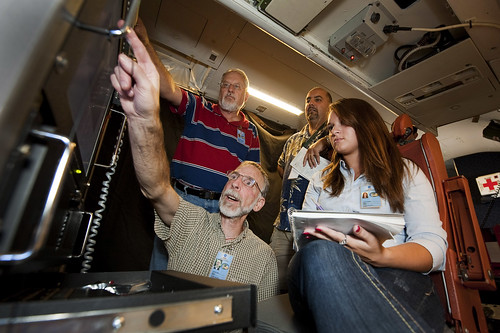
There is a brief profile of our crowd-sourcing project VerbCorner on SciStarter.com, with a number of quotes form yours truly.
SciStarter profiles a lot of Citizen Science / Crowd-sourced Science projects. Interestingly, most are physical sciences, with only one project listed under psychology (interestingly, also a language project).
This is not a feature of SciStarter but more a feature of Citizen Science. The Scientific American database only lists two projects under "mind and brain" -- and I'm pretty sure they didn't even have that category last time I checked. This is interesting, because psychologists have been using the Internet to do research for a very long time -- probably longer than anyone else. But we've been very late to the Citizen Science party.
Not, of course, that you shouldn't want to participant in non-cognitive science projects. There are a bunch of great ones. I've personally mostly only done the ones at Zooniverse, but SciStarter lists hundreds.
- Home
- Angry by Choice
- Catalogue of Organisms
- Chinleana
- Doc Madhattan
- Games with Words
- Genomics, Medicine, and Pseudoscience
- History of Geology
- Moss Plants and More
- Pleiotropy
- Plektix
- RRResearch
- Skeptic Wonder
- The Culture of Chemistry
- The Curious Wavefunction
- The Phytophactor
- The View from a Microbiologist
- Variety of Life
Field of Science
-
-
Change of address8 months ago in Variety of Life
-
Change of address8 months ago in Catalogue of Organisms
-
-
Earth Day: Pogo and our responsibility11 months ago in Doc Madhattan
-
What I Read 20241 year ago in Angry by Choice
-
I've moved to Substack. Come join me there.1 year ago in Genomics, Medicine, and Pseudoscience
-
-
-
-
Histological Evidence of Trauma in Dicynodont Tusks7 years ago in Chinleana
-
Posted: July 21, 2018 at 03:03PM7 years ago in Field Notes
-
Why doesn't all the GTA get taken up?7 years ago in RRResearch
-
-
Harnessing innate immunity to cure HIV9 years ago in Rule of 6ix
-
-
-
-
-
-
post doc job opportunity on ribosome biochemistry!11 years ago in Protein Evolution and Other Musings
-
Blogging Microbes- Communicating Microbiology to Netizens11 years ago in Memoirs of a Defective Brain
-
Re-Blog: June Was 6th Warmest Globally11 years ago in The View from a Microbiologist
-
-
-
The Lure of the Obscure? Guest Post by Frank Stahl13 years ago in Sex, Genes & Evolution
-
-
Lab Rat Moving House14 years ago in Life of a Lab Rat
-
Goodbye FoS, thanks for all the laughs14 years ago in Disease Prone
-
-
Slideshow of NASA's Stardust-NExT Mission Comet Tempel 1 Flyby15 years ago in The Large Picture Blog
-
in The Biology Files
Peaky performance
Right now there is a giant spike of traffic to GamesWithWords.org, following Steve Pinker's latest tweet about one of the experiments (The Verb Quiz). I looked back over the five years since I started using Google Analytics, and you can see that in general traffic to the site is incredibly peaky.
The three largest single-day peaks account for over 10% of all the visitors to the site over that time period.
Moral of the story: I need Pinker to tweet my site every day!
The three largest single-day peaks account for over 10% of all the visitors to the site over that time period.
Moral of the story: I need Pinker to tweet my site every day!
Findings: GamesWithWords.org at DETEC2013
I recently returned from the inaugural Discourse Expectations: Theoretical, Experimental, and Computational Perspectives workshop, where I presented a talk ("Three myths about implicit causality") which ties together a lot of the pronoun research that I have been doing over the last few years, including results from several GamesWithWords.org experiments (PronounSleuth, That Kind of Person, and Find the Dax).
VerbCorner: New and improved, with surprise bonuses
After a month-long tour, VerbCorner returned to the garage for some fine-tuning. There are now bonus points in each task, doled out whenever ... well, play to find out!
The other major change is that you no longer have to log in to participate. This way, people can check VerbCorner out before committing to filling out the registration form. (Though please do register).
We also made a number of other tweaks here and there to make the site easier to use.
The other major change is that you no longer have to log in to participate. This way, people can check VerbCorner out before committing to filling out the registration form. (Though please do register).
We also made a number of other tweaks here and there to make the site easier to use.
Keeping up to date
Recently, we've added several methods of keeping up to date on GamesWithWords.org projects (finding out when results of old studies are available, when new studies are posted, etc.). In addition to following this blog, that is.
1. Join the GamesWithWords.org Google Group for occasional (5x/year) email updates.
2. Follow @gameswithwords on Twitter.
3. Like our Facebook page.
Citizen Science: Rinse & Repeat
One of the funny things about language is that everybody has their own. There is no "English" out there, existing independently of all its speakers. Instead, there are about one billion people out there, all of whom speak their own idiolect. Most likely, no two people share exactly the same vocabulary (I know some words you might not, possibly including idiolect, and you know some words I don't). Reasonable people can disagree about grammar rules, particularly if one is from Florida and the other from Northern Ireland.
This is one of the reasons we decided to ask people to create usernames in order to contribute to VerbCorner. Suppose two people answer the same question on VerbCorner but disagree. One possibility is that one of them made a mistake (which happens!). But another possibility is that they actually speak different dialects of English, and both are correct (for their dialect). It's hard to tell these possibilities apart by looking at just one question, but by looking at their answers to a set of questions, we can start to get a handle on whether this was a mistake or a real disagreement. The more answers we get from the same person -- particularly across different tasks -- the easier it is to do these analyses.
If we didn't have usernames, it would be hard to figure out which answers all belong to the same person. This is particularly true if the same person comes back to the website from time to time.
People are coming back. At last check, we have ten folks who have answered over 500 questions and four who have answered over 1000. (You can see this by clicking "more" on the leader-board on the main page).
Still, it would be great if we had even more folks who have answered large numbers of questions. Our goal is to have everyone in the top 20 to have answered at least 500 questions by the end of the month.
This is one of the reasons we decided to ask people to create usernames in order to contribute to VerbCorner. Suppose two people answer the same question on VerbCorner but disagree. One possibility is that one of them made a mistake (which happens!). But another possibility is that they actually speak different dialects of English, and both are correct (for their dialect). It's hard to tell these possibilities apart by looking at just one question, but by looking at their answers to a set of questions, we can start to get a handle on whether this was a mistake or a real disagreement. The more answers we get from the same person -- particularly across different tasks -- the easier it is to do these analyses.
If we didn't have usernames, it would be hard to figure out which answers all belong to the same person. This is particularly true if the same person comes back to the website from time to time.
People are coming back. At last check, we have ten folks who have answered over 500 questions and four who have answered over 1000. (You can see this by clicking "more" on the leader-board on the main page). Still, it would be great if we had even more folks who have answered large numbers of questions. Our goal is to have everyone in the top 20 to have answered at least 500 questions by the end of the month.
What makes a sentence ungrammatical?
This is the latest in a series of posts explaining the scientific motivations for the VerbCorner project.
There are many sentences that are grammatical but don't make much sense, including Chomsky's famous “colorless green ideas sleep furiously,” and sentences which seemed perfectly interpretable but are grammatical, such as “John fell the vase” or “Sally laughed Mary” (where the first sentence means that John caused the vase to fall, and the second sentence means that Sally made Mary laugh). You can hit at a window or kick at a window but not shatter at a window or break at a window (unless you are the one shattering or breaking!).
Sentence frames
Notice that these are not agreement errors (“Sally laughed”) or other word-ending errors ("Sally runned to the store"), but instead have something to do with the structure of the sentence as a whole. Linguists often refer to these sentence structures as "frames". There is the transitive frame (NOUN VERB NOUN), the intransitive frame (NOUN VERB), the 'at' frame (NOUN VERB at NOUN), etc. And it seems that certain verbs can go in some frames but not others.
There are many sentence frames (there is disagreement about exactly how to count them, but there are at least a few dozen), and most verbs can appear in somewhere around a half dozen of them. For instance, "thump" can appear in at least eight frames:
NOUN VERB NOUN: John thumped the door.
NOUN VERB NOUN with NOUN: John thumped the door with a stick.
NOUN VERB NOUNs together: John thumped the sticks together.
NOUN VERB NOUN ADJECTIVE: John thumped the door open.
NOUN VERB NOUN ADJECTIVE with NOUN: John thumped the door open with a stick.
NOUN VERB NOUN to [STATE]: John thumped the door to pieces.
NOUN VERB NOUN to [STATE] with NOUN: John thumped the door to pieces with a stick.
NOUN VERB NOUN against NOUN: John thumped the stick against the door.
But there are a large number of frames "thump" can't appear in (at least, not without a lot of straining), such as:
NOUN VERB NOUN that SENTENCE: John thumped that Mary was angry.
NOUN VERB NOUN NOUN: John thumped Mary the book.
NOUN VERB easily: Books thump easily.
There VERB NOUN out of [LOCATION]: There thumped John out of the house.
NOUN VERB what INFINITIVE: John thumped what to do.
NOUN VERB INFINITIVE: John thumped to sing
Explaining language
Perhaps these are just funny facts that we must learn about the language we speak, with no rhyme or reason. This is probably true for some aspects of grammar, like which verbs are irregular (that the past tense of “sleep” is “slept” is a historical accident). But a lot of researchers have suspected that there is a reason why language is the way it is and why certain verbs can go into certain frames but not others.
Going back several decades, researchers noticed that when you sort sentences based on the kind of sentence frames they can fit into, you do not get incoherent jumbles of verbs, but rather groups of verbs that all seem to share something in common. So “shatter” and “break” can be used with the object that is shattering or breaking as the direct object ("John shattered/broke the vase") or as the subject ("The vase shattered/broke"). All the verbs that can do this seem to describe some caused change of state (the vase is changing). Verbs that do not describe some kind of caused change cannot appear in both of these forms (you can say “John hit/kicked the vase" but not "The vase hit/kicked" -- at least not without a very special vase!).
Causality might also explain why you can hit at a window or kick at a window but not shatter or break at a window: the addition of the preposition "at" suggests that the action was ineffectual (you tried hitting the window without doing much damage) which is simply nonsensical with words that by their very definition require success. How do you ineffectually shatter a window? You either shatter it or you don't.
So maybe which verbs can go in which frames is not so mysterious after all. Maybe it is a simple function of meaning. Certain verbs have the right meanings for certain sentence frames. No more explanation necessary.
The VerbCorner Contribution
When you group verbs based on the frames they can appear in, you get several hundred groups of verbs in English. Of these, only a handful have been studied in any detail. While it does look like those groups can be explained in terms of their meaning, you might wonder if perhaps these are unusual cases, and if researchers looked at the rest, we would find something different. In fact, a number of researchers have wondered just that.
The difficulty has always been that there are a lot of verbs and a lot of groups. Studying just one group can take a research team years. Studying all of them would take lifetimes.
This is why we decided to crowd-source the problem. Rather than have a few people spend a lifetime, if a lots of people each contribute just a little, we can finish the project in a couple years, if not sooner.
Contribute to the VerbCorner project at gameswithwords.org/VerbCorner/
There are many sentences that are grammatical but don't make much sense, including Chomsky's famous “colorless green ideas sleep furiously,” and sentences which seemed perfectly interpretable but are grammatical, such as “John fell the vase” or “Sally laughed Mary” (where the first sentence means that John caused the vase to fall, and the second sentence means that Sally made Mary laugh). You can hit at a window or kick at a window but not shatter at a window or break at a window (unless you are the one shattering or breaking!).
Sentence frames
Notice that these are not agreement errors (“Sally laughed”) or other word-ending errors ("Sally runned to the store"), but instead have something to do with the structure of the sentence as a whole. Linguists often refer to these sentence structures as "frames". There is the transitive frame (NOUN VERB NOUN), the intransitive frame (NOUN VERB), the 'at' frame (NOUN VERB at NOUN), etc. And it seems that certain verbs can go in some frames but not others.
There are many sentence frames (there is disagreement about exactly how to count them, but there are at least a few dozen), and most verbs can appear in somewhere around a half dozen of them. For instance, "thump" can appear in at least eight frames:
NOUN VERB NOUN: John thumped the door.
NOUN VERB NOUN with NOUN: John thumped the door with a stick.
NOUN VERB NOUNs together: John thumped the sticks together.
NOUN VERB NOUN ADJECTIVE: John thumped the door open.
NOUN VERB NOUN ADJECTIVE with NOUN: John thumped the door open with a stick.
NOUN VERB NOUN to [STATE]: John thumped the door to pieces.
NOUN VERB NOUN to [STATE] with NOUN: John thumped the door to pieces with a stick.
NOUN VERB NOUN against NOUN: John thumped the stick against the door.
But there are a large number of frames "thump" can't appear in (at least, not without a lot of straining), such as:
NOUN VERB NOUN that SENTENCE: John thumped that Mary was angry.
NOUN VERB NOUN NOUN: John thumped Mary the book.
NOUN VERB easily: Books thump easily.
There VERB NOUN out of [LOCATION]: There thumped John out of the house.
NOUN VERB what INFINITIVE: John thumped what to do.
NOUN VERB INFINITIVE: John thumped to sing
Explaining language
Perhaps these are just funny facts that we must learn about the language we speak, with no rhyme or reason. This is probably true for some aspects of grammar, like which verbs are irregular (that the past tense of “sleep” is “slept” is a historical accident). But a lot of researchers have suspected that there is a reason why language is the way it is and why certain verbs can go into certain frames but not others.
Going back several decades, researchers noticed that when you sort sentences based on the kind of sentence frames they can fit into, you do not get incoherent jumbles of verbs, but rather groups of verbs that all seem to share something in common. So “shatter” and “break” can be used with the object that is shattering or breaking as the direct object ("John shattered/broke the vase") or as the subject ("The vase shattered/broke"). All the verbs that can do this seem to describe some caused change of state (the vase is changing). Verbs that do not describe some kind of caused change cannot appear in both of these forms (you can say “John hit/kicked the vase" but not "The vase hit/kicked" -- at least not without a very special vase!).
Causality might also explain why you can hit at a window or kick at a window but not shatter or break at a window: the addition of the preposition "at" suggests that the action was ineffectual (you tried hitting the window without doing much damage) which is simply nonsensical with words that by their very definition require success. How do you ineffectually shatter a window? You either shatter it or you don't.
So maybe which verbs can go in which frames is not so mysterious after all. Maybe it is a simple function of meaning. Certain verbs have the right meanings for certain sentence frames. No more explanation necessary.
The VerbCorner Contribution
When you group verbs based on the frames they can appear in, you get several hundred groups of verbs in English. Of these, only a handful have been studied in any detail. While it does look like those groups can be explained in terms of their meaning, you might wonder if perhaps these are unusual cases, and if researchers looked at the rest, we would find something different. In fact, a number of researchers have wondered just that.
The difficulty has always been that there are a lot of verbs and a lot of groups. Studying just one group can take a research team years. Studying all of them would take lifetimes.
This is why we decided to crowd-source the problem. Rather than have a few people spend a lifetime, if a lots of people each contribute just a little, we can finish the project in a couple years, if not sooner.
Contribute to the VerbCorner project at gameswithwords.org/VerbCorner/
Bad Evolutionary Arguments
The introductory psychology course I teach for is very heavy on evolutionary psychology. The danger with evolutionary explanations is that it's pretty easy to come up with bad ones. Here's the best illustration I've seen, from Saturday Morning Breakfast Cereal:
How do you tell a good evolutionary argument from a bad one? It's hard to test them with experiments, but that doesn't mean you can't get data. Nice supporting evidence would be finding another species that does the same thing. This hypothesis makes the clear -- and almost certainly false -- prediction that people are likely to adopt babies that fly in out of the blue. You would want to show that whatever reproductive advantage comes from having your genes spread widely (adopted children themselves have more children?) is not overwhelmed by the disadvantages of not being raised by your biological parents (there is data showing that, all else equal, step-parents invest lest in step-children than biological parents invest in their biological children. I expect this generalizes to adoptive parents, but I'm not sure; it might be confounded in modern day by the rigorous screening of adoptive parents).
Etc. We try to teach our students to critically evaluate evolutionary hypotheses. Hopefully it has taken.
Citizen Science Project: Likely Events
VerbCorner was our first step towards opening up the rest of the process. I have just opened up a new good to segment of the website called “Experiment Creator”, which is our second endeavor.
Experiment Creator
One of the most important parts of language experiments is choosing the stimuli. For many types of research, such as in many low level or mid-level vision projects, the experimenter has free reign to design essentially what ever stimuli they like. Language researchers are constrained by the fact that someone suggest other words don't, and each word that has the properties you want may also have other properties that you don't want along for the ride. For instance, you might want to compare nouns and verbs, which don't just differ in terms of part of speech but also frequency (there are many very low-frequency nouns) and length (in some languages, nouns will be systematically longer than verbs; in other languages, it will be the reverse).
Typically, we have to run one or more “norming” experiments to choose stimuli that are controlled for various nuisance factors. These are not really experiments. There is no hypothesis. The purpose of the experiment is indirect (it's an experiment to create another experiment). So I usually do not post them at gameswithwords.org, which recruits people who want to participate in experiments.
The new Experiment Creator project changes this. The tasks posted there will be meta-experiments, used to choose stimuli for other experiments. I just posted the first one, Likely Events.
Likely Events
One of the big discoveries about language in the last few decades is that when we are listening to someone talk or reading a passage, we are actively predicting what will come next. If you hear “John needed money, so he went to the…” you probably expect the next word to be “ATM," not “hibernate.” There are two reasons: 1) "the" is usually followed by a noun, not a verb, and 2) "hibernate" is a relatively rare word.
Much of this research has focused on word frequency and what words follow what other words. We are developing several projects to look more carefully at predictions based not on what word follows what word but on what event is likely to follow what event. In general, "the street" is a more common sequence of words than "the ATM" and "street" is more common than "ATM", but you probably didn't think that the example sentence above was likely to end with "street" for a simple reason: That's not (usually) where you go when you need money.
To do this research, we need to have sequences of events and vary how likely it is that the one event would follow the other, as well as how likely each event is to happen on its own. And we need many, many such sequences. If you would like to help us out, you can do so here.
On the theory that the people interested in these projects will be more committed, Likely Events takes a bit longer than our typical project (in order to make up for the smaller number of volunteers). I expect participation will take on the order of half an hour. We will see how this goes and how many people are interested. Feedback is welcome.
VerbCorner: A Citizen Science project to find out what verbs mean
Earlier this week, I blogged about our new VerbCorner project. At the end, I promised that there would be more info forthcoming about why we are doing this project, about its aims and expected outcomes, why it's necessary, etc. Here's the first installment in that series.
Computers and language
I just dictated the following note to Siri
The problem of meaning.
I don't know for sure how Siri works, but her mistake is emblematic of how much language software works. Computer systems treat and Computer system street sound approximately the same, but that's not something most humans would notice because the first interpretation makes sense and the second one doesn't.
Decades of research shows that human language comprehension is heavily guided by plausibility: when there are two possible interpretations of what you just heard, go for the one that makes sense. This happens speech recognition like in the example above, and it plays a key role in understanding ambiguous words. If you want to throw Google Translate for a look, give it the following:
So what's the problem?
I assume that this limitation is not lost on the people at Google or at Apple. And, in fact, there are computer systems that try to incorporate meaning. The problem there is not so much the computer science as the linguistic science.** Dictionaries notwithstanding, scientists really do not know very much about what words mean, and it is hard to program the computer to know what the word means when you actually do not know.
(Dictionaries are useful, but as an exercise, pick* definition from a dictionary and come up with a counterexample. It is not hard.)
One of the limitations is scope. Language is huge. There are a lot of words. So scientists will work on the meanings of a small number of words. This is helpful, but a computer that only knows a few words is pretty limited. We want to know the meanings of all words.
Solving the problem
We've launched a new section of the website, VerbCorner. There, you can answer questions about what verbs mean. Rather than try to work out the meaning of a word all at once, we have broken up the problem in a series of different questions, each of which tries to pinpoint a specific component of meaning. Of course, there are many nuances to meaning, but research has shown that certain aspects are more important that others, and we will be focusing on those.
I will be writing a lot more about this project, it's goals, the science behind it, and the impact we expect it to have over the coming weeks. In the meantime, please check it out.
----
*Dragon Dictate originally transcribed this as "pickled", which I did not catch on proofreading. More evidence that we need computer programs that understand what words mean.
**Dragon Dictate make spaghetti out of this sentence, too.
Computers and language
I just dictated the following note to Siri
Many of our best computer systems treat words as essentially meaningless symbols that need to be moved around.Here's what she wrote
Many of our best computer system street words is essentially meaningless symbols that need to be moved around.I rest my case.
The problem of meaning.
I don't know for sure how Siri works, but her mistake is emblematic of how much language software works. Computer systems treat and Computer system street sound approximately the same, but that's not something most humans would notice because the first interpretation makes sense and the second one doesn't.
Decades of research shows that human language comprehension is heavily guided by plausibility: when there are two possible interpretations of what you just heard, go for the one that makes sense. This happens speech recognition like in the example above, and it plays a key role in understanding ambiguous words. If you want to throw Google Translate for a look, give it the following:
John was already in his swimsuit as we reached the watering hole. "I hope the tire swing is still there," John said as he headed to the bank.Although the most plausible interpretation of bank here is side of a river, Google Translate will translate it into the word for "financial institution" in whatever language you are translating into, because that's the most common meaning of the English work bank.
So what's the problem?
I assume that this limitation is not lost on the people at Google or at Apple. And, in fact, there are computer systems that try to incorporate meaning. The problem there is not so much the computer science as the linguistic science.** Dictionaries notwithstanding, scientists really do not know very much about what words mean, and it is hard to program the computer to know what the word means when you actually do not know.(Dictionaries are useful, but as an exercise, pick* definition from a dictionary and come up with a counterexample. It is not hard.)
One of the limitations is scope. Language is huge. There are a lot of words. So scientists will work on the meanings of a small number of words. This is helpful, but a computer that only knows a few words is pretty limited. We want to know the meanings of all words.
Solving the problem
We've launched a new section of the website, VerbCorner. There, you can answer questions about what verbs mean. Rather than try to work out the meaning of a word all at once, we have broken up the problem in a series of different questions, each of which tries to pinpoint a specific component of meaning. Of course, there are many nuances to meaning, but research has shown that certain aspects are more important that others, and we will be focusing on those.
I will be writing a lot more about this project, it's goals, the science behind it, and the impact we expect it to have over the coming weeks. In the meantime, please check it out.
----
*Dragon Dictate originally transcribed this as "pickled", which I did not catch on proofreading. More evidence that we need computer programs that understand what words mean.
**Dragon Dictate make spaghetti out of this sentence, too.
Citizen Science at GamesWithWords.org: The VerbCorner Project
What do verbs mean? We'd like to know. For that reason, we just launched VerbCorner, a massive, crowd-sourced investigation into the meanings of verbs.
Why do we need this project? Why not just look up what verbs mean in a dictionary? While dictionaries are enormously useful (I think I own something like 15), they are far from perfect. For one thing, it's usually very easy to find counter-examples even for what seem like straight-forward definitions. Take the following:
At VerbCorner, rather than trying to work out the whole definition at once, we have broken meaning into many different components. At the site, you will find several different tasks. In each task, you will try to determine whether a particular verb has a particular component of meaning.
If you are interested in what words mean and would like to help with this project, sign up for an account at http://gameswithwords.org/VerbCorner/. Participation can be anonymous, but we are happy to recognize significant contributions from anyone who wishes it.
I will be writing a lot more about this project, it's goals, the science behind it, and the impact we expect it to have over the coming weeks. In the meantime, please check it out.
Why do we need this project? Why not just look up what verbs mean in a dictionary? While dictionaries are enormously useful (I think I own something like 15), they are far from perfect. For one thing, it's usually very easy to find counter-examples even for what seem like straight-forward definitions. Take the following:Bachelor: An unmarried man.So is the Pope a bachelor? Is Neil Patrick Harris? How about a married man from a country in which men are allowed multiple wives?
At VerbCorner, rather than trying to work out the whole definition at once, we have broken meaning into many different components. At the site, you will find several different tasks. In each task, you will try to determine whether a particular verb has a particular component of meaning.
If you are interested in what words mean and would like to help with this project, sign up for an account at http://gameswithwords.org/VerbCorner/. Participation can be anonymous, but we are happy to recognize significant contributions from anyone who wishes it.
I will be writing a lot more about this project, it's goals, the science behind it, and the impact we expect it to have over the coming weeks. In the meantime, please check it out.
A Critical Period for Learning Language?
If you bring adults and children into the lab and try teaching them a new language, adults will learn much more of the language much more rapidly than the children. This is odd, because probably one of the most famous facts about learning languages -- something known by just about everyone whether you are a scientist who studies language or not -- is that adults have a lot less success at learning language than children. So whatever it is that children do better, it's something that operates on a timescale too slow to see in the lab.
This makes studying the differences between adult and child language learners tricky, and a lot less is known that we'd like. Even the shape of the change in language learning ability is not well-known: is the drop-off in language learning ability gradual, or is there a sudden plummet at a particular age? Many researchers favor the latter possibility, but it has been hard to demonstrate simply because of the problem of collecting data. The perhaps most comprehensive study comes from Kenji Hakuta, Ellen Bialystok and Edward Wiley, who used U.S.A. Census data from 2,016,317 Spanish-speaking immigrants and 324,444 Chinese-speaking* immigrants, to study English proficiency as a function of when the person began learning the language.
Their graph shows a very gradual decline in English proficiency as a function of when the person moved to the U.S.
Unfortunately, the measure of English proficiency wasn't very sophisticated. The Census simply asks people to say how well they speak English: "not at all", "not well", "well", "very well", and "speak only English". This is better than nothing, and the authors show that it correlates with a more sophisticated test of English proficiency, but it's possible that the reason the lines in the graphs look so smooth is that this five-point scale is simply too coarse to show anything more. The measure also collapses over vocabulary, grammar, accent, etc., and we know that these behave differently (your ability to learn a native-like accent goes first).
A New Test
This was something we had in mind when devising The Vocab Quiz. If we get enough non-native Speakers of English, we could track English proficiency as a function of age ... at least as measured by vocabulary (we also have a grammar test in the works, but that's more difficult to put together and so may take us a while yet). I don't think we'll get two million participants, but even just a few thousand would be enough. If English is your second (or third or fourth, etc.) language, please participate. In addition to helping us with our research and helping advance the science of language in general, you will also be able to see how your vocabulary compares with the typical native English speaker who participates in the experiment.
--------
Hakuta, K., Bialystok, E., & Wiley, E. (2003). Critical Evidence: A Test of the Critical-Period Hypothesis for Second-Language Acquisition Psychological Science, 14 (1), 31-38 DOI: 10.1111/1467-9280.01415
*Yes, I know: Chinese is a family of languages, not a single language. But the paper does not report a by-language breakdown for this group.
Living in an Imperfect World: Psycholinguistics Edition
You, sir, have tasted two whole worms. You have hissed all my mystery lectures and been caught fighting a liar in the quad. You will leave Oxford by the next town drain. -- Reverend Spooner.
There is an old tension in psycholinguistic (or linguistic) theory, which boils down to two ways of looking at language comprehension. When somebody says something to you, what do you do with that linguistic input? Is your goal to decode the sentence and figure out what the sentence means, or do you try to figure out what message the speaker intended to convey? The tension comes in because presumably we do a bit of both.
Suppose a young child says, "Look! A doggy!" while pointing to a cat. Most people will agree that technically, the child's sentence is about a dog. But most of can still work out that probably the child meant to talk about the cat; she used the word doggy either due to lack of vocabulary, confusion about the distinction between dogs and cats, or a simple speech error. Similarly, if your friend says at 7pm, "Let's go have lunch," technically your friend is suggesting having the midday meal, but probably you charitably assume he is just very hungry and so made a mistake in saying "lunch" instead of "dinner".
For a variety of reasons, linguistics and psycholinguistics have focused mostly on decoding sentences rather than intended meanings. This is important work about an important problem, but -- as we saw above -- it's only half the story. PNAS just published a paper by Gibson, Bergen, and Piantadosi that addresses the second half. Gibson and Bergen are at M.I.T., and Piantadosi recently graduated from M.I.T., and like much of the work coming out of Eastern Cambridge lately, they take a Bayesian perspective on the problem, and point out that the probability that the speaker intended to convey a particular message m given that they said sentence s is proportional to the prior probability that the speaker might want to convey m times the probability that they would say sentence s when intending to convey m.
This ends up accounting for the phenomenon brought up in Paragraph #2: If the literal meaning of the speaker's sentence isn't very likely to be what they intended to say ("Let's go have lunch", spoken at 7pj), but there is some other sentence that contains roughly the same words but has a more plausible meaning ("Let's go have dinner"), then you should infer that the intended message is the latter one and that the speaker made an error.
So far, this is not much more than a restatement of our intuitive theory in Paragraph #2. But a Gibson, Bergen and Piantadosi point out that a few non-trivial predictions come out of this. One is that you should assume that deletions (dropping a word) are more likely than insertions (adding a word). The reason is that there are only so many words that can be dropped from a particular sentence, so even if the probability of accidentally dropping a word is low, the probability of accidentally dropped a particular word isn't all that much lower. So if the intended sentence was "The ball was kicked by the girl", and the speaker accidentally dropped two words, the probability that the speaker happened to drop "was" and "by", resulting in the grammatical but unlikely sentence "The ball kicked the girl" is not so bad. However, suppose the intended sentence was "The girl kicked the ball", what are the chances the speaker accidentally adds "was" and "by", resulting in the grammatical but unlikely sentence "The girl was kicked by the ball"? Pretty much zilch, since English contains hundreds of thousands of words: There is pretty much no chance that those particular words would be inserted in those particular locations?
The authors present some data to back up these and some other predictions. For instance, if listeners are given reason to suspect that the speaker makes lots of speech errors, they are then even more likely to "correct" an unlikely sentence to a similar sentence with a more likely meaning.
There's plenty more work to be done. There are plenty of speech errors out there besides insertions and deletions, such as substitutions and the various phonological errors that made Rev. Spooner famous (see quote above). Work on phonological errors shows that speaker are more likely to make errors that result in real words (train->drain) than non-words (train->frain). Likely, the same is true of other types of errors. Building a full theory that incorporates all the complexity of speech processes is a ways off yet. But the work just published is an important proof of concept.
---------
Gibson, E., Bergen, L., and Piantadosi, S. (2013). Rational integration of noisy evidence and prior semantic expectations in sentence interpretation Proceedings of the National Academy of Sciences DOI: 10.1073/pnas.1216438110
There is an old tension in psycholinguistic (or linguistic) theory, which boils down to two ways of looking at language comprehension. When somebody says something to you, what do you do with that linguistic input? Is your goal to decode the sentence and figure out what the sentence means, or do you try to figure out what message the speaker intended to convey? The tension comes in because presumably we do a bit of both.
Suppose a young child says, "Look! A doggy!" while pointing to a cat. Most people will agree that technically, the child's sentence is about a dog. But most of can still work out that probably the child meant to talk about the cat; she used the word doggy either due to lack of vocabulary, confusion about the distinction between dogs and cats, or a simple speech error. Similarly, if your friend says at 7pm, "Let's go have lunch," technically your friend is suggesting having the midday meal, but probably you charitably assume he is just very hungry and so made a mistake in saying "lunch" instead of "dinner".
For a variety of reasons, linguistics and psycholinguistics have focused mostly on decoding sentences rather than intended meanings. This is important work about an important problem, but -- as we saw above -- it's only half the story. PNAS just published a paper by Gibson, Bergen, and Piantadosi that addresses the second half. Gibson and Bergen are at M.I.T., and Piantadosi recently graduated from M.I.T., and like much of the work coming out of Eastern Cambridge lately, they take a Bayesian perspective on the problem, and point out that the probability that the speaker intended to convey a particular message m given that they said sentence s is proportional to the prior probability that the speaker might want to convey m times the probability that they would say sentence s when intending to convey m.
This ends up accounting for the phenomenon brought up in Paragraph #2: If the literal meaning of the speaker's sentence isn't very likely to be what they intended to say ("Let's go have lunch", spoken at 7pj), but there is some other sentence that contains roughly the same words but has a more plausible meaning ("Let's go have dinner"), then you should infer that the intended message is the latter one and that the speaker made an error.
So far, this is not much more than a restatement of our intuitive theory in Paragraph #2. But a Gibson, Bergen and Piantadosi point out that a few non-trivial predictions come out of this. One is that you should assume that deletions (dropping a word) are more likely than insertions (adding a word). The reason is that there are only so many words that can be dropped from a particular sentence, so even if the probability of accidentally dropping a word is low, the probability of accidentally dropped a particular word isn't all that much lower. So if the intended sentence was "The ball was kicked by the girl", and the speaker accidentally dropped two words, the probability that the speaker happened to drop "was" and "by", resulting in the grammatical but unlikely sentence "The ball kicked the girl" is not so bad. However, suppose the intended sentence was "The girl kicked the ball", what are the chances the speaker accidentally adds "was" and "by", resulting in the grammatical but unlikely sentence "The girl was kicked by the ball"? Pretty much zilch, since English contains hundreds of thousands of words: There is pretty much no chance that those particular words would be inserted in those particular locations?
The authors present some data to back up these and some other predictions. For instance, if listeners are given reason to suspect that the speaker makes lots of speech errors, they are then even more likely to "correct" an unlikely sentence to a similar sentence with a more likely meaning.
There's plenty more work to be done. There are plenty of speech errors out there besides insertions and deletions, such as substitutions and the various phonological errors that made Rev. Spooner famous (see quote above). Work on phonological errors shows that speaker are more likely to make errors that result in real words (train->drain) than non-words (train->frain). Likely, the same is true of other types of errors. Building a full theory that incorporates all the complexity of speech processes is a ways off yet. But the work just published is an important proof of concept.
---------
Gibson, E., Bergen, L., and Piantadosi, S. (2013). Rational integration of noisy evidence and prior semantic expectations in sentence interpretation Proceedings of the National Academy of Sciences DOI: 10.1073/pnas.1216438110
Do You Speak Korean?
Learning new languages is hard for many reasons. One of those reasons is that the meaning of an individual word can have a lot of nuances, and the degree to which those nuances match up with the nuances of similar words in your first language can make learning the new language easier; the degree to which the nuances diverge can make learning the
new language harder.
In a new experiment, we are looking at English-speakers learning Korean and Korean-speakers learning English. In particular, we are studying a specific set of words that previous research has suggested give foreign language learners a great deal of difficulty.
We are hoping that we will be able to track how knowledge of these words develops as you move from being a novice to a fluent speaker. For this, we will need to find a lots of people who are learning Korean, as well as Korean-speakers who are learning English. If you are one, please participate.
The experiment is called "Trials of the Heart". You can find it here.
We do also need monolingual English speakers (people whose first and essentially only language is English) for comparison, so if you that's you, you are welcome to participate, too!
Image credit
Evolutionary Psychology, Proximate Causation, & Ultimate Causation
Evolutionary psychology has always been somewhat controversial in the media for reasons that generally confuse me (Wikipedia has a nice rundown of the usual complaints). For instance, the good folks at Slate are particularly hostile (here, here and here), which is odd because they are also generally hostile towards Creationism (here, here and here).
Given the overwhelming evidence that nearly every aspect of the human mind and behavior is at least partly heritable (and so at least partially determined by our genes), the only way to deny the claim that our minds are at least partially a product of evolution is to deny that evolution affects our genes – that is, deny the basic tenants of evolutionary theory. (I suppose you could try to deny the evidence of genetic influence on mind and behavior, but that would require turning a blind eye to such a wealth of data as to make Global Warming Denialism seem like a warm-up activity).
What's the matter with Evolutionary Psychology?
What is there to object to, anyway? Some of the problem seems definitional. Super-Science-Blogger Greg Laden acknowledges that applying evolutionary theory to the study of the human mind is a good idea, but that "evolutionary psychology" refers only to a very specific theory from Cosmides and Tooby, one with which he takes issue. And in general, a lot of the "critiques" I see in the media seem to involve equating the entire field with some specific hypothesis or set of hypotheses, particularly the more exotic ones.
For instance, some years back Slate ran an article about "Evolutionary Psychology's Anti-Semite", a discussion of Kevin MacDonald, who has an idiosyncratic notion of Judaism as a "group evolution strategy" to maximize, through eugenics, intelligence (the article goes into some detail). It's a pretty nutty idea, gets basic historical facts wrong, and more importantly gets the science wrong. The article tries pretty hard to paint him as a mainstream Evolutionary Psychologist nonetheless. Interviewees aren't that helpful (they mostly dismiss the work as contradicting basic fundamentals of evolutionary theory), but the article author pulls up other evidence, like the fact that MacDonald acknowledged some mainstream researchers in one of his books. (For the record, I acknowledge Benicio del Toro as an inspiration, so you know he fully agrees with everything in this blog post. Oh, and Jenna-Louise Coleman, too.)
In a similar vein:
This spring, New York Times columnist John Tierney asserted that men must be innately more competitive than women since they monopolize the trophies in -- hold onto your vowels -- world Scrabble competitions. To bolster his case, Tierney turned to evolutionary psychology. In the distant past, he argued, a no-holds-barred desire to win would have been an adaptive advantage for many men, allowing them to get more girls, have more kids, and pass on their competitive genes to today's word-memorizing, vowel-hoarding Scrabble champs.
I will agree that this argument involves a bit of a stretch and is awfully hard to falsify (as the article goes on to point out). And sure, some claims made even by serious evolutionary psychologists are hard to falsify with current technology ... but then so is String Theory. And we do have many methods for testing evolutionary theory in general, and roughly the same ones work whether you are studying the mind and behavior or purely physical attributes of organisms. So, again, if you want to deny that claims about evolutionary psychology are testable, then you end up having to make roughly the same claim about evolutionary theory in general.
Just common sense
It turns out that when you look at the biology, a good waist-hips ratio for a healthy woman is (roughly) .7, whereas the ideal for men is closer to .9. Now imagine we have a species of early hominids (Group A) that is genetically predispositioned such as that heterosexual men prefer women with a waist-hips ratio of .7 and heterosexual women prefer men with a waist-hips ratio of .9. Now let's say we have another species of early hominids (Group B) where the preferences are reversed, preferring men with ratios of .7 and women with ratios of .9. Since individuals of Group A prefer to mate with healthier partners than Group B does, which one do you think is going to have more surviving children?
Now compare to Group C, where there is no innate component to interest in waist-hips ratios; beauty has to be learned. Group C is still at a disadvantage to Group A, since some of the people in it will learn to prefer the wrong proportions and preferentially mate with less healthy individuals. In short, all else equal, you would expect evolution to lead to hominids that prefer to mate with hominids that have close-to-ideal proportions.
(If you don't like waist-hips ratios, consider that humans prefer individuals without deformities and gaping sores and boils, and then play the same game.)
Here is another example. Suppose that in Group A, individuals find babies cute, which leads them to want to protect and nourish the infants. In Group B, individuals find babies repulsive, and many actually have an irrational fear of babies (that is, treating babies something like how we treat spiders, snakes & slugs). Which one do you think has more children that survive to adulthood? Once again, it's better to have a love of cuteness hardwired in rather than something you have to learn from society, since all it takes is for a society to get a few crazy ideas about what cute looks like ("they look better decapitated!") and then the whole civilization is wiped out.
(If you think that babies just *are* objectively cute and that there's no psychology involved, consider this: Which do you find cuter, a human baby or a skunk baby? Which do you think a mother skunk finds cuter?)
These are the kinds of issues that mainstream evolutionary psychology trucks in. And the theory does produce new predictions. For instance, you'd expect that in species where a .7 waist-hips ratio is not ideal for females (that is, pretty much any species other than our own), it wouldn't be favored (and it isn't). And the field is generally fairly sensible, which is not to say that all the predictions are right or that evolutionary theory doesn't grow and improve over time (I understand from a recent conversation that there is now some argument about whether an instinct for third-party punishment is required for sustainable altruism, which is something I had thought was a settled matter).
Subscribe to:
Comments (Atom)