


This is one of several posts based on readings and discussion from a graduate seminar on language acquisition that I have been attending.
Modern syntactic theory is complex. When I diagrammed sentences in middle school, it looked something like this diagram from A Walk in the WoRds blog:

That seemed complicated at the time but is child's play compared with what one finds in many syntax papers. For instance, here is a tree from Beatrice Santorini & Anthony Kroch's syntax textbook:
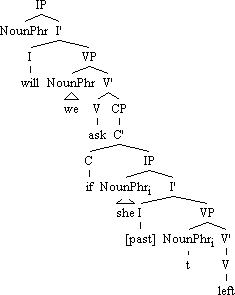
Here's another one from Christopher Davis's online class notes at UMass-Amherst:

Something that pops out about these trees are the various symbols that don't seem to do anything. For instance, saying "smelly dog" involves and adjective and a noun makes sense, but in Davis's tree above, there are extra symbols such as A'. The Santorini & Kroch tree makes considerable use of "inflectional phrases," which weren't a part of the sentence diagrams I learned in school.
Is grammar really so complex?
For a number of years now, Michael Tomasello has been arguing that perhaps linguistic structure is not nearly so complex and does not require nearly so many abstract components (like inflectional phrases), particularly in the case of child speech. A lot of the abstraction in linguistic theory is meant to explain how you know what constructions a given word appears in. For instance, compare the sentences below:
(1) Sarah rolled the orange.
(2) The orange rolled.
(3) Sarah ate the orange.
(4) *The orange ate.
The fourth sentence should sound ungrammatical (which is what the asterisk means). The question is: how do you know that the verb roll can be used in this way but the verb eat cannot? Theories make use of abstract grammatical structure to explain these and other generalizations (the abstractions in the sentence trees at the top of this post are motivated by other considerations, but the idea is the same).
Tomasello's point is that in fact young children and even adults typically do not use words in a wide variety of constructions -- therefore, you don't actually need such abstract linguistic theories. This is a useful push-back, and the claim has generated a lot of research. It is interesting, however, that Tomasello is presenting a theory that explains what people do say, but he is arguing against theories that explain what people can say, which turn out to be quite different things. Although nobody is likely to say the sentence in (5), we all know that it is grammatical.
(5) We all shall have told the story to the Martians.
A complete theory needs to explain that phenomenon, too.
More on spoken language
Part of Tomasello's argument is that an abstract grammar would predict more variability in the constructions people (particularly children) actually use than are seen in real life. Charles Yang has recently argued that this is not the case (see Who's Afraid of George Kingsley Zipf). In fact, people are very repetitive. Moreover, even if a given word can be used in many constructions, there may be no reason to use all those constructions. Sentence (5) was an example of this: the verb tell can be used in the first-person plural future perfect (we all shall have told), but it's hard to imagine many circumstances in which one would need to.
Despite the complex math in the paper, Yang's manuscript is more than worth the read.
Modern syntactic theory is complex. When I diagrammed sentences in middle school, it looked something like this diagram from A Walk in the WoRds blog:


That seemed complicated at the time but is child's play compared with what one finds in many syntax papers. For instance, here is a tree from Beatrice Santorini & Anthony Kroch's syntax textbook:
Here's another one from Christopher Davis's online class notes at UMass-Amherst:
Something that pops out about these trees are the various symbols that don't seem to do anything. For instance, saying "smelly dog" involves and adjective and a noun makes sense, but in Davis's tree above, there are extra symbols such as A'. The Santorini & Kroch tree makes considerable use of "inflectional phrases," which weren't a part of the sentence diagrams I learned in school.
Is grammar really so complex?
For a number of years now, Michael Tomasello has been arguing that perhaps linguistic structure is not nearly so complex and does not require nearly so many abstract components (like inflectional phrases), particularly in the case of child speech. A lot of the abstraction in linguistic theory is meant to explain how you know what constructions a given word appears in. For instance, compare the sentences below:
(1) Sarah rolled the orange.
(2) The orange rolled.
(3) Sarah ate the orange.
(4) *The orange ate.
The fourth sentence should sound ungrammatical (which is what the asterisk means). The question is: how do you know that the verb roll can be used in this way but the verb eat cannot? Theories make use of abstract grammatical structure to explain these and other generalizations (the abstractions in the sentence trees at the top of this post are motivated by other considerations, but the idea is the same).
Tomasello's point is that in fact young children and even adults typically do not use words in a wide variety of constructions -- therefore, you don't actually need such abstract linguistic theories. This is a useful push-back, and the claim has generated a lot of research. It is interesting, however, that Tomasello is presenting a theory that explains what people do say, but he is arguing against theories that explain what people can say, which turn out to be quite different things. Although nobody is likely to say the sentence in (5), we all know that it is grammatical.
(5) We all shall have told the story to the Martians.
A complete theory needs to explain that phenomenon, too.
More on spoken language
Part of Tomasello's argument is that an abstract grammar would predict more variability in the constructions people (particularly children) actually use than are seen in real life. Charles Yang has recently argued that this is not the case (see Who's Afraid of George Kingsley Zipf). In fact, people are very repetitive. Moreover, even if a given word can be used in many constructions, there may be no reason to use all those constructions. Sentence (5) was an example of this: the verb tell can be used in the first-person plural future perfect (we all shall have told), but it's hard to imagine many circumstances in which one would need to.
Despite the complex math in the paper, Yang's manuscript is more than worth the read.