Field of Science

What you missed on the Internet last week - 10/8/2012


My Nomination for the Ignoble
Gibbons on helium.

Fraud vs. Questionable Practices
Neuroskeptic worries that discussions of reforming science often conflate fraud and questionable practices (like the file drawer problem), when probably they have different causes and different solutions. Of the two, Neuroskeptic argues, questionable practices cause more damage.

Fake Standardized Tests
BishopBlog worries that the DoE's new phonics test may be based on faked data.

Advice for how to learn foreign languages


I am often asked for advice on how to learn second languages. I have written a few popular-press articles on the topic before, but these articles are mostly high-level advice, whereas the questions I usually get asked are specific (what books should I read, where should I study, etc.), so I thought it was time to write up the resources that I have found useful.

First, a disclaimer: What I write below is based only on my own experience learning languages. While I am a language researcher, I know no more about the research into second-language learning than the run-of-the-mill psycholinguist (that is, what you would learn by overhearing water-cooler conversations and attending talks at conferences). Second, I make no claim to be Ken Hale's second coming; that is, I'm not an especially gifted language-learner, just a persistent one.  I leave to the reader to decide whether that gives me more or less insight into the problem.

Textbooks

I cannot say enough good things about Japanese For Busy People. The title comes from the fact that the chapters are bite-sized. You can work through one in half an hour or less. The series is designed to get you speaking as quickly as possible, and so focuses on words and phrases you might actually need. (This might seem like an obvious strategy, but it did not occur to the writers of my introductory Russian textbook, which filled opening pages with words for, for instance, 18th century Russian course-drawn carriages.)

Difusion publishes a series of fantastic, conversation-based textbooks, such as Gente and Aula, at least some of which were (I'm told) developed in collaboration with my favorite language school (see below). Like Japanese For Busy People, these books use short lessons focused on high-frequency words and phrases, and provide many useful exercises (the more you practice, the more you learn).


I have used a few Mandarin textbooks. My favorite is the Integrated Chinese series, which comes in both traditional and simplified character versions. It's not as impressive an achievement as the Japanese and Spanish books I mentioned above, but a solid resource.

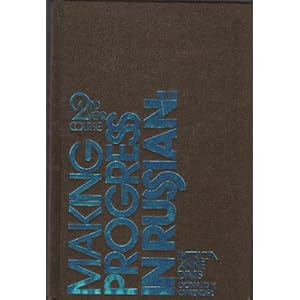
I haven't had as much luck with Russian textbooks, though I do have a soft spot in my heart for Making Progress in Russian (the classic 1973 text by Davis and Oprendek, not the more recent revival -- I warn you, it isn't easy to find), which is meant for intermediate students. This is not a great text for learning to speak, and especially not for learning to speak modern spoken Russian (it was because of what I learned from this textbook that one my professors in Russia told me, "You speak such beautiful Russian. Like Leo Tostoy!" which wasn't really the effect I was going for). But I appreciate its thoroughness and precision.

Schools


I have studied at several specialized language schools. I can't imagine a better one than La Escuela de Idiomas Nerja. Many of the teachers that I had in 2005 (and wrote about here) are now gone , but Paco Dueñas, who seemed to me to be the heart and soul of the institution, is still there, so I expect it is still as good. If you want to learn Spanish, I cannot imagine any faster way to do it than attend this school.

The Mandarin Training Center in Taipei, Taiwan, and the Russian Language & Culture Institute at Smolnyi in St. Petersburg, Russia, were less mind-blowing than La Escuela de Idiomas, but  and solid emersion options that served me well.


Podcasts and Online courses


These days, I find that I have little time for textbooks and certainly no time to go spend a couple months in Nerja. But I have a lot of time to listen to podcasts, especially in the gym (be kind to your ears and use a safe volume; there is no point in learning a language if you are just going to go deaf in 15 years. The real trick here is to find a gym that is quiet enough that you can keep the volume down). Here is what I listen to:


ChinesePod & SpanishPod -- the only resources on this list that require subscriptions -- are high quality mini lessons, which involve various exercises on their website, an optional phone app, and a downloadable podcast. I haven't found the phone app all that useful, and I can't say I ever actually had time to use the website, but I love the podcasts, which teach some new vocabulary based around a conversation and provide a lot of useful cultural context. Plus they are just fun to listen to.

On the topic of Internet sites, I should point out DuoLingo, brainchild of the incomparable Luis von Ahn, in which you can learn a new language (currently, you can choose between Spanish, French, German or English), while helping translate pages on the Internet (seriously). I haven't used it a great deal (again -- little time or patience for working through problem sets on the Internet), but I have poked around the Spanish site a bit, and it seems very good.

There are a couple other podcasts meant for language-learners that deserve mention. Notes in Spanish, while not as polished as SpanishPod, is free. The aptly-named "Slow Chinese" podcast provides short audio essays on various topics, using advanced vocabulary but at a slow pace (helpful for the learner).

Otherwise, I listen to a lot of news in foreign languages:  In Russian, I get my daily business news from the Vedemosti podcast (Vedemosti is the Russian equivalent of the Wall Street Journal). I also really like NHK, a Russian-language international news broadcast from Tokyo. I occasionally listen to BBSeva (from the BBC), but I find the half-hour format too constraining to listen to it regularly. In Spanish, my favorite show is from RFI (based in France), which covers mostly European and Latin-American news, though I sometimes also listen to Cinco Continentes, which is produced in Spain and similarly covers international news.

I am continually looking for short-form podcasts on non-news topics (as interesting as it is to hear the international news from several different perspectives, it does get repetitive), but I haven't had much luck, and many of the podcasts that I enjoyed have closed up shop. Right now, I occasionally listen to a science podcast called "A hombros de gigantes", which covers a range of scientific topics, both historical essays and current events, but takes around an hour to do so, and I don't always have an hour available.

Books

The other primary way I keep up my foreign languages is reading books in those languages. One particularly good option is to re-read a favorite book , translated into the language you want to work on. (Right now, I'm reading His Dark Materials in Russian.)

But the best is...


Many of the methods listed above are focused on receptive language. That's fine, but you learn more by actually trying to produce language. So nothing is better than having a friend who is fluent in the language and is willing to talk to you in it (and who has the discipline not to break back into English). Pen-pals are also good, even if the pen-pal is yourself. (When I keep a travel journal, mainly because I often travel to the same places repeatedly, and it's helpful to remember where that restaurant you really liked was. A little while ago, I started keeping it in Spanish so that I'd get at least some minimum amount of writing in Spanish in every so often.)

And personally I'm much more motivated to learn a language when I actually have someone to speak it with!


What you missed on the Web last week - 10/1/2012 edition


Forgetting kanji
Japanese computer users say they are forgetting how to handwrite kanji due to computer use. The number has increased from 10 years ago. An important question not addressed is whether they can write more kanji using a computer now than people could write by hand 10 years ago. (Hat tip: LanguageLog)

Another descriptivist/presciptivist debate
What I learned from it: I'm not the only one whose idiolect does not distinguish between relative clauses beginning with 'that' and 'which'.

Science spam
Neuroskeptic notices a dramatic rise in science spam (irrelevant conference announcements, lab products, etc.). Am I glad I'm not the only one, or sad for the world?

Animal research @ Freakonomics
A Freakonomics blogger writes that while he's generally against animal research, he supposes it might be OK if it led to saving human life. In response, Isis writes "This is someone who is pleading for us to understand animals, but is unwilling to understand where the basic health care that has enabled us (of the first world, primarily) to live as long as we do [comes from]". Or understand much of anything else. The author thinks one of the problems is that we don't understand animals well enough yet; presumably we'll understand them better if we stop studying them. The rest of the article has some other interesting flights of fancy.

PLoS retraction policy
PLoS declares that it will retract any paper, the conclusions of which turn out to be incorrect. I wish them luck in figuring out when something passes that threshold.

Is science growing too fast?
Some time ago, I worried that as more and more papers become published, it'll become impossible to keep up with the literature. Neuroskeptic crunches the numbers.

Predicting my h-index

A new article in Nature presents a model for predicting a neuroscientist's future h-index based on current output. For those who don't know, the h-index is the largest N such that you have N papers each of which have at least N citations. It does this based on your current h-index, total number of published articles, years since first article, the total number of journals published in, and the number of papers in Nature, Science, Nature Neuroscience, PNAS and Neuron.

I'm not a neuroscientist (though I *am* in Neurotree, upon which the data are based), so I figured I'd see what it predicts for me. I ran into a problem right away, though: how do we count papers? Does my book chapter count? How about two editorials that were recently published (that is, non-empirical papers appears in empirical journals)? What about two papers that are in press but not yet published?

If we are conservative and count only empirical papers and only papers currently in print, my predicted h-index in 2022 is 12:

If we count everything I've published -- that is, including papers in press, book chapters, and non-empirical papers -- things improve somewhat (apparently it's a good thing that almost everything I publish is in different outlets):


Interestingly, if I pretend that I currently have an h-index of 9 (that is, all my papers have been cited at least 9 times), it doesn't actually do any good. I've increased my current h-index by 6 but only my predicted 2022 h-index by 3:

I guess the model has discovered regression to the mean.

(BTW I've noticed that neuroscientists really like h-index, probably because they cite each other so much. H-indexes in other fields, such as -- to take a random example -- psychology, tend to be much lower.)


Strange language fact of the day

Apparently in some languages/cultures, it is common to call an infant "Mommy". Even a boy infant. I am told by reliable sources this is true of Bengali and of Tzez. Reportedly Bengladeshi immigrants try to import this into English and get weird looks at the daycare.

I am told that this is actually relatively common and appears in many languages. And there are some phenomena in English that aren't so different. You can, for instance, say the pot is boiling when you in fact mean that the water in the pot is boiling, not the pot itself. You can ask for someone's hand in marriage, even though you probably want the entire person, not just the hand. So words can sometimes stand in for other words.

It still blows my mind, though. And I'd love to hear what a Whorfian had to say about it.

Around the Internet: What you missed last week (9/17/2012 edition)

Chomsky
OK, not technically last week, but here's a longish post critiquing Chomsky and a much longer, heated discussion in the comments, from BishopBlog.

Replication
A nice editorial on the important of replicating as a way of dealing with fraud.

The New Yorker Still Hates Science (esp. Evolution)
When I first heard the claim that the New Yorker was fundamentally anti-science, it came as a surprise. Then I thought back through what they publish, and it became less surprising. Now, reading this out-of-touch, anti-evolution tirade isn't surprising at all (my favorite part is where Gottlieb writes that understanding evolution is superfluous and a waste of time).

Pricing conundrum

Before I went to Riva del Garda for this year's AMLaP, I picked up a travel guide on my Kindle. (If only such things had existed the years I backpacked in Eurasia. My strongest memories are of how much my backpack weighed. Too many books.)

Oddly, the Lonely Planet Italian Lakes Region guide is the exact same price as the whole Italy guide. These local guides tend to be glorified excerpts of the country book, and since they both weigh the same...

Estimating replication rates in psychology

The Open Science Collaboration's interim report, which will come out shortly in Perspectives in Psychological Science, is available. We nearly pulled off the physics trick of having a paper where the author list is longer than the paper itself. I think there are nearly 70 of us (if you scroll down, you'll find me in the H's).

The abstract says it all:
Reproducibility is a defining feature of science. However, because of strong incentives for innovation and weak incentives for confirmation, direct replication is rarely practiced or published. The Reproducibility Project is an open, large-scale, collaborative effort to systematically examine the rate and predictors of reproducibility in psychological science. So far, 72 volunteer researchers from 41 institutions have organized to openly and transparently replicate studies published in three prominent psychological journals from 2008. Multiple methods will be used to evaluate the findings, calculate an empirical rate of replication, and investigate factors that predict reproducibility. Whatever the result, a better understanding of reproducibility will ultimately improve confidence in scientific methodology and findings.
If you are interested in participating, there is still time. Go to the website for more information. 

Around the Internet - 8/31


Publication
A warning about the perils of preprint repositories.

Statistical evidence that writing book chapters isn't worth the effort. (Though caveat: the author also doesn't find evidence of higher citation rates for review papers in journals, which I had thought was well-established.)

One person who finds things to like in the publication process (I know, I don't link to these often).

Neuroskeptic argues that we don't necessarily want to increase replication, just replicability. (Agreed, but how do we know if replicability rates are high enough without conducting replications?)

Language
Did Chris Christie really talk about himself too much in Tampa? 

Other Cognitive Science
Cognitive load disrupts implicit theory of mind processing. So maybe the reason young children succeed at implicit tasks isn't because those tasks don't require executive processing (whether they require less is still up for grabs).

Lying with statistics

One of the most concise explanations of why your units of measurement matter, courtesy of XKCD:


Revision, Revision, Revision

I have finally been going through the papers in the Frontiers Special Topic on publication and peer review in which my paper on replication came out. One of the arguments that appears in many of these papers (like this one)* -- and many discussions of the review process, is that when papers are published, they should be published along with the reviews.

My experience with the process -- which I admit is limited -- is that you submit a paper, reviewers raise concerns, and you only get published if you can revise the manuscript so as to address those concerns (which may include new analyses or even new experiments). At that stage, the reviews are a historical document, commenting on a paper that no longer exists. This may be useful to historians of science, but I don't understand how it helps the scientific process (other than, I suppose, transparency is a good thing).

So these proposals only make sense to me if it is assumed that papers are *not* typically revised in any meaningful way based on review. That is, reviews are more like book reviews: comments on a finished product. Of my own published work, three papers were accepted more-or-less as is (and frankly I think the papers would have benefited from more substantial feedback from the reviewers). So there, the reviews are at least referring to a manuscript very similar to the one that appeared in print (though they did ask me to clarify a few things in the text, which I did).

Other papers went through more substantial revision. One remained pretty similar in content, though we added a whole slew of confirmatory analyses that were requested by reviewers. The most recent paper actually changed substantially, and in many ways is a different -- and much better! -- paper than what we originally submitted. Of the three papers currently under review, two of them have new experiments based on reviewer comments, and the other one has an entirely new introduction and general discussion (the reviewers convinced me to re-think what I thought the paper was about). So the reviews would help you figure out which aspects of the paper we (the authors) thought of on our own and which are based on reviewer comments, but even then that's not quite right, since I usually get comments from a number of colleagues before I make the first submission. There are of course reviews from the second round, but that's often just from one or two of the original reviewers, and mostly focuses on whether we addressed their original concerns or not.

So that's my experience, but perhaps my experience is unusual. I've posted a poll (look top right). Let me know what your experience is. Since this may vary by field, feel free to include comments to this post, saying what field you are in.

---
*To be fair, this author is describing a process that has actually been implemented for a couple Economics journals, so apparently it works to (at least some) people's satisfaction.

Have you seen me before?

I have been using PCA to correct blink artifact in an EEG study that I am presenting at AMLaP in a couple weeks. Generally, I think I've gotten pretty good at detecting blinks. I do see other things that look like artifact but which I don't understand as well. For instance, look at this channel plot:
(You should be able to increase the size of the picture by opening it in a new window). So this looks a bit like a blink, but it's in the wrong place entirely. This is a 128 electrode EGI cap, with the electrodes listed sequentially (the top one is electrode 1 and the bottom is electrode 124 -- I don't use electrodes 125-128 because they tend not to have good contact with the skin).

The way EGI is laid out, the low-numbered electrodes and high-numbered electrodes are in the front, whereas the middle-numbered electrodes are in the back (check this picture), So basically what I'm seeing is being generated in the back of the head. Actually, the back left of the head, according to my PCA:
In this, the top left panel shows the localization of the signal. The top right panel shows which trials the signal occurred in. The power spectrum (bottom panel) is also quite odd. I'm going ahead and removing this component, because it's clearly artifact (the amplitude looks way too large to be true EEG), and it affects so many trials that I can't just exclude them without excluding the participant. But I'd really like to know what this is. Because maybe I *should* be excluding the participant.

So...has anyone seen something like this before?

For those wondering...

Using PCA, I was able to get rid of this artifact fairly cleanly. Here's is an imagine before removal, with the 124 electrodes stacked on one another:
You can see that strange artifact -- which looks like a blink but not quite as smooth as your typical blink -- very easily in these four trials.

Here are the same four trials after I subtracted that component, plus another component that probably is blink-related (there were two, classic-looking blinks in my data; the component above found both of those *and* those two blinks; the other component found only the two classic blinks):
You can see that the odd artifact is gone from all four trials, both otherwise, things look very similar.

Around the Internet - 7/30/2012


Citations

There have been a bunch of posts lately on citations and the Impact Factor. I started with these two posts by DrugMonkey. These posts have links to others in the chain, which you can follow. Here's a slightly older post (from late July) on reasons to self-cite.

Next topic

So I didn't actually see anything else interesting this week. Possibly because I've been trying to streamline a bootstrapping analysis (which I may blog about when I finally get it done). Early in the process, I tried to estimate how long it would take for the script to run and realized it was about 1 week for each analysis, of which I have several to do. So I started hurriedly looking for ways to speed it up...

New source of post-doctoral funding

NSF has just announced what appears to be a new post-doctoral fellowship. The document linked to lists two different tracks: Broadening Participation and Interdisciplinary Research in Behavioral and Social Sciences. It is the second one that seems to be new. Here's the heart of the description:
Track 2. Interdisciplinary Research in Behavioral and Social Sciences (SPRF-IBSS): The SPRF-IBSS track aims to support interdisciplinary training where at least one of the disciplinary components is an SBE science ... The proposal must be motivated by a compelling research question (within the fields of social, behavioral and economic sciences) that requires an interdisciplinary approach for successful investigation. As a result, applicants should demonstrate the need for new or additional skills and expertise beyond his or her core doctoral experience to achieve advances in the proposed research. To acquire the requisite skills and competencies (which may or may not be within SBE sciences), a mentor in the designated field must be selected so that the postdoctoral research fellow and his or her mentor will complement, not reinforce, each other's expertise. 

What I get from this is that the fellowship will be particularly useful for someone with training in one field who wants to get cross-trained in another. Thinking close to home, this might be a psycholinguist who wants training in linguistics or computer science. This makes me think of the legendary IGERT program at UPenn, which trained a string of linguists to use psychological research methods, many of whom are now among my favorite researchers. Which is to say that this cross-training can be very productive.