Field of Science

Lie detection

A few pioneering lawyers have been attempting to use fMRI-based lie detection tests in court. I don't have any broad numbers, but it seems most neuroimagers I talk to are deeply skeptical of such tests, at least at the current stage of technology (and whether such technology can ever catch pathological liars is yet another question).

At a recent talk at Harvard, Michael Gazzaniga related the following argument from a colleague on the law end of things: whether fMRI-based lie detection is "good enough" is not a scientific question but a legal one. After all, the law allows all kinds of scientifically-suspect "evidence" into the courtroom as is (eye-witness testimony, fingerprinting, etc.). Present all data (along with information about how reliable it is) to the jury and let the jury sort it out.

That's one conclusion that could be drawn. Another is that perhaps it's time to step back and come up with a broad policy for how evidence is introduced into the legal system.

Why Is Nobody Studying Klingon?

Doing research for the recent Scientific American Mind article, I found out that Klingon uses the incredibly rare object-verb-subject (OVS) word order. Even though some languages (like Russian) allow relatively free word-order, all languages seem to have a preferred order. There are 6 possible. The most common are SVO (English), SOV (Japanese), VSO (Classical Arabic). The 3 orders that put the object before the subject are relatively rare, with OVS nearly non-existent. It does appear occasionally in poetry or other marked uses (The drink drank I), and is claimed to be the dominant word order in at least two extremely rare languages: Guarijio and Hixkaryana. Given the degree of debate over how to correctly characterize syntax in well-studied languages like English, I'm always maintain some skepticism about rare, poorly-studied languages (and the sad truth is that all languages are poorly-studied when compared to English).

In any case, if one wanted to study the acquisition of Guarijio or Hixkaryana, one would need a decent travel budget and some infrastructure. Klingon is spoken closer to home. Yet I couldn't find any papers in Google Scholar looking at the acquisition of Klingon, even from a sociological perspective. This seems under-studied.

Science blogging and the law

The Kennedy School at Harvard had a conference on science journalism. Among the issues discussed were legal pitfalls science bloggers can run into. Check out this blog post at the Citizen Media Law Project.

Texting during sex

"Teens surprisingly OK with texting during sex," notes Slate's news aggregator. This seemed like a good lead for a piece I've wanted to write for a while: just how much we should trust claims that 10% of people agree to claim X. In many cases, we probably should put little faith in those numbers.

As usual, Stephen Colbert explains why. In his infamous roast of George W Bush, he notes

Now I know there's some polls out there that say this man has a 32 percent approval rating ... Pay no attention to people who say the glass is half empty .. because 32 percent means it's 2/3 empty. There's still some liquid in that glass, is my point. But I wouldn't drink it. The last third is usually backwash.
This was meant as a dig at those who still supported Bush, but there's a deeper point to be made: there's a certain percentage of people who, in a survey, will say "yes" to anything.

Numbers

For instance, many of my studies involve asking people's opinions about various sentences. In a recent one I ran on Amazon Mechanical Turk, I presented people with sentence fragments and asked them which pronoun they thought would likely be the next word in the sentence:

John went to the store with Sally. She/he...

In that case, it could be either pronoun, so I'm trying to get a sense of what people's biases are. However, I put in some filler trials just to make sure people were paying attention:

Billy went to the store with Alfred. She/he...

In this case, it's really, really unlikely the pronoun will be "she," since there aren't any female characters in the story. Even so, over 4% of the time participants still clicked on "she." This wasn't an issue of some of the participants simply being bad. I included 10 such sentences, and nobody only one person got more than 1 of these wrong. However, a lot of people did manage to miss 1 ... probably because they simply were sloppy, made a mistake, were momentarily not thinking ... or because they really thought the next word would be "she."

Those numbers are actually pretty good. In another, slightly harder experiment that I ran on my website, people didn't do so well. This one was shorter, so I included only 4 "catch trials" -- questions for which there was only one reasonable answer. Below is a pie chart of the participants, according to how many of these they got right:


You can see that over half got them all right, but around a quarter missed 1, and a significant sliver got no more than 50% correct. This could suggest many things: my questions weren't as well-framed as I thought, I had a lot of participants who weren't paying attention, some people were deliberately goofing off, etc.

Poll numbers

This isn't a problem specific to experiments. As we all learned in 2000, a certain number of people accidentally vote for the wrong candidate through some combination of not paying attention and poor ballot design.

So there is a difference between a survey finding that 10% of teens say that they think texting during sex is fine and 10% of teens actually thinking that texting during sex is fine. A good survey will incorporate methods of sussing out who is pulling the surveyor's leg (or not paying attention, or having a slip of the tongue, etc.).

Real Surveys

I didn't want to unnecessarily pick on this particular study, so I tried to hunt down the original source to see if they had done anything to protect against the "backwash" factor. Slate linked to a story on mashable.com. Mashable claimed that the research was done by the consumer electronics shopping and review site Retrevo, but only linked to Retrevo's main page, not any particular article. I did find a blog on Retrevo that frequently presents data from surveys, but nothing this year matched the survey in question (though this comes close). I found several other references to this study using Google, but all referenced Retrevo.

If anyone knows how to find the original study, I'd love to see it -- but if it doesn't exist, it wouldn't be the first apocryphal study. So it turns out that the backwash effect isn't the only thing to be careful of when reading survey results.

UPDATE

I have since heard from Revetro. See here.

NSF budget

It seems the current director of the National Science Foundation thinks it's unlikely NSF will get much of a budget increase this coming year (if any), despite Obama's pledge of an 8% increase. Oh well, it was nice while it lasted.

Data wants to be free

It seems that the National Science Foundation will be asking new grant applications to submit a data management plan, apparently including plans for how to make their data available to others.

I have mixed feelings about this. I certainly approve of high-value data sets being made available. I've benefitted a great deal from the wonderful people who put together Penn Tree Bank, VerbNet and similar projects. There are now some useful data sets included in libraries for R as well. I intend to make the summary data from my pronoun studies available when I publish the associated papers.

That said, getting data together in a manner that its interpretable and usable by somebody else is hard. However much I document my own data, whenever I have to go back to look at some old data it takes hours if not days to figure out what I'm looking at. And I'm the one who created it. Fully documenting a data set for someone not associated with the project takes time.

Given that NSF will be paying the salaries of the people who spend the time to document the data sets, it's reasonable to ask whether it's cost-effective. Just how much of a demand is there for data from other labs? I can think of many papers for which I wish I had the original stimuli. The number for which I want the original data are much smaller (though there are some for which it would be really useful).

How many commercial brands does your kid know?

A recently published study by Anna McAlister and T. Bettina Cornwell at the University of Michigan reports that smarter kids are more affected by branding and know more brands. A number of people are interested in this because the naive prediction might have been that smarter people (including kids) should be less impressionable and less susceptible to marketing, rather than more. 

The study caught my eye because it is a nice example of a problem that developmental psychologists run into. One question a developmental psychologist might be interested in is at what age children acquire a particular ability (like susceptibility to branding). This type of research has implications for education, public policy, etc. But the age you get depends on the age of the kids you test. 

It happens to be the case that the children who are most easily recruited into developmental psychology studies tend to be relatively advanced. This happens for a number of reasons. Developmental labs tend to be in universities, which tend to be surrounded by relatively affluent, well-educated communities. Even within a community, not all parents are equally likely to bring their kid into do a study, and those that do seem to often be the sorts of parents that have advanced children. Many studies may disproportionately test children of professors and graduate students. It's easy to imagine additional reasons.

Unfortunately, there is a problem with the direct link to the study. It should be the top study on this Google Scholar search.

Class Notes: Verb Islands

This is one of several posts based on readings and discussion from a graduate seminar on language acquisition that I have been attending.

Modern syntactic theory is complex. When I diagrammed sentences in middle school, it looked something like this diagram from A Walk in the WoRds blog:


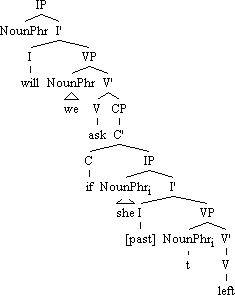
That seemed complicated at the time but is child's play compared with what one finds in many syntax papers. For instance, here is a tree from Beatrice Santorini & Anthony Kroch's syntax textbook:


Here's another one from Christopher Davis's online class notes at UMass-Amherst:


Something that pops out about these trees are the various symbols that don't seem to do anything. For instance, saying "smelly dog" involves and adjective and a noun makes sense, but in Davis's tree above, there are extra symbols such as A'. The Santorini & Kroch tree makes considerable use of "inflectional phrases," which weren't a part of the sentence diagrams I learned in school.

Is grammar really so complex?

For a number of years now, Michael Tomasello has been arguing that perhaps linguistic structure is not nearly so complex and does not require nearly so many abstract components (like inflectional phrases), particularly in the case of child speech. A lot of the abstraction in linguistic theory is meant to explain how you know what constructions a given word appears in. For instance, compare the sentences below:

(1) Sarah rolled the orange.
(2) The orange rolled.
(3) Sarah ate the orange.
(4) *The orange ate.

The fourth sentence should sound ungrammatical (which is what the asterisk means). The question is: how do you know that the verb roll can be used in this way but the verb eat cannot? Theories make use of abstract grammatical structure to explain these and other generalizations (the abstractions in the sentence trees at the top of this post are motivated by other considerations, but the idea is the same).

Tomasello's point is that in fact young children and even adults typically do not use words in a wide variety of constructions -- therefore, you don't actually need such abstract linguistic theories. This is a useful push-back, and the claim has generated a lot of research. It is interesting, however, that Tomasello is presenting a theory that explains what people do say, but he is arguing against theories that explain what people can say, which turn out to be quite different things. Although nobody is likely to say the sentence in (5), we all know that it is grammatical.

(5) We all shall have told the story to the Martians.

A complete theory needs to explain that phenomenon, too.

More on spoken language

Part of Tomasello's argument is that an abstract grammar would predict more variability in the constructions people (particularly children) actually use than are seen in real life. Charles Yang has recently argued that this is not the case (see Who's Afraid of George Kingsley Zipf). In fact, people are very repetitive. Moreover, even if a given word can be used in many constructions, there may be no reason to use all those constructions. Sentence (5) was an example of this: the verb tell can be used in the first-person plural future perfect (we all shall have told), but it's hard to imagine many circumstances in which one would need to.

Despite the complex math in the paper, Yang's manuscript is more than worth the read.

Invented Languages

Those who haven't already seen it might be interested in my article about the role of invented languages in science at ScientificAmerican.com.

Results: The Best and Worst Puns

The Puntastic experiment continues to chug along. 1,376 participants have contributed 59,474 ratings of nearly 2,000 different puns. Currently, the most popular pun is

"To some, marriage is a word; to others, a sentence."

Every participant who has rated that so far has given it the maximum 5 stars. 

The second most popular is:

"The frustrated cannibal threw up his hands."

By far the least popular one is:

"People adorned with Bogus Deuterium Ingots aroused suspicion. Most people said they didn't trust anyone with BDIs."

I'm curious whether this is because people really hate this pun, or because they simply didn't get it. I actually think it's kind of funny.

I'm still collecting data, so if you haven't voted for your favorite puns yet, there is still time.

Web Experiment Tutorial: Chapter 10, Recruiting Participants

Several years ago, I wrote a tutorial for my previous lab on how to create Web-based experiments in Flash. This is the final chapter in the original tutorial.


10. Recruiting participants online


1.     Overview

So now you have an experiment implemented on the Web. All you need are participants. Where do you get them?

If you need only very small numbers of subject (50-100), this part is easy. If you want larger numbers of subjects, or if you want to run several experiments under the same URL (so as to prevent the same subject from participating in multiple versions of the experiment), this may be the most challenging part of Web-based experiments.

There are several methods you can use. I recommend using all of them. Each will be discussed below in turn, but briefly: you can list the experiments on experiment portal pages, you can recruit from within your own social network, you can buy ads, you can promote the experiments in online forums, you can blog, you can swap links with other researchers, and you can get media attention.

Media attention, if you can get it, is far more valuable than all those other methods combined.

2.     Experiment portal pages

There are several web sites that list online experiments. By far the one that has provided the most subjects to vacognition is:


The second-most useful is:


Others, much less useful, include:


Another place you can list is:


In the first 3 weeks of May, 2007, vacognition (my previous site) received 251 hits from psych.hanover, 67 from genpsylab-wexlist, 15 from onlinepsychresearch, and only 2 from language-experiments.

Here are some other lists I have not used, which may or may not be useful:


3.     Your social network

Your own friends and family are the most likely to be convinced to do your experiments. Some of them may pass along the URL to their friends and family. Every time I have sent out requests to my F&F, I get about 40-50 participants in various studies.

You can also use Web-based social networking. For instance, I have an account on Facebook.com. My page lists vacognition. A friend of mine created a Facebook “group” called “Harvard Studied My Brain.” We invited all our friends to join (about 200), and anybody on Facebook could in theory join if they found the group in a search. 35 people did join, and many more have clicked on the link.

To make the group more enticing, I created a “certificate of membership,” which members can download. Generally, it is good to think about why anybody would want to participate. What can you do to make it more fun?

Other social networking sites include Stumbleupon.com, Reddit.com and Digg.com. “vacognition” has accounts for all of those. Every time a new webpage mentions your website, it is a good idea to “vote” for that website on Stumbleupon, Reddit and Digg. This increases the likelihood people will surf to that page, and then to your page. However, these services only have an effect if a fairly large number of people vote for the site, and the traffic may or may not be high-quality. At one point, a number of people voted for vacognition on StumbleUpon. In the space of an hour, we suddenly got 150 visitors. However, most did not participate in any experiments, and the traffic died down within 90 minutes. This is likely due to the fact that users of StumbleUpon are randomly sent to the website. In contrast, users of Digg or Reddit know what sort of website they are going to and are more likely to actually be interested. Visitors we have gotten through Digg have been highly likely to participate in an experiment.

You can also add a link to your website as part of your email signature. Ask your labmates to do so as well. Ask your friends to link to your website from their websites.

4.     Purchasing ads

You can also purchase ads. One obvious place to put ads is Google. I have never tried this.

I did, however, buy adds on Facebook. For $5/day, Facebook promised to display my add to at least 10,000 people on the Oberlin network. For another $5/day, it was displayed to another 10,000 people in the Harvard network.

I bought $20 worth of ads as an experiment. Vacognition got about 80 hits. That’s 4/$1. This is not very impressive, but it may be worth it. Also, my ads may not have been very good. (Keep in mind that a hit to the website does not mean that the person completed or even started an experiment!)

5.     Online forums

Another way to recruit participants is to mention the website or a particular experiment in an online forum. Here, it is particularly important to make the post relevant to the forum discussion. Otherwise, you are spamming and may (not unfairly) receive hate mail.

There are many psychology or science forums. It may be perfectly fair to write a post called “Please help me finish this experiment.” Another option is to write about the topic you are studying (“Visual short-term memory is very limited. We are trying to find out exactly hoe limited. Please do this experiment.”). You can also be very oblique about it. Post something interesting about your area of research, and just mention your website (“It turns out 1/100 people have prosopagnosia from a young age, not as a result of stroke. This is something we’ve found through our online experiments at www.faceblind.org. In fact, blah blah blah.”)

You can also pick targeted forums. If you are studying reading, you can post on dyslexia or reading education forums. (“My colleagues and I are trying to better understand reading. The results may eventually help us better understand how to teach reading to children. We need volunteers for our short, 3-4 minute experiments. I thought that participants in this forum might be particularly interested…”)

Because I use Flash for my experiments, I have also posted on forums dealing with Flash programming (“You may be interested in this other application of Flash technology…”). Also, sometimes I have a question about Flash, and I post the question, with a link.

There are also website creation forums where you are encouraged to showcase your website.

The best success I have had with this method is when my experiment has been set up as a type of quiz. My visual short-term memory experiment gives people a score at the end. So I posted the experiment on several forums where people advertise quizzes (“How good is your short-term memory for what you see?”). Normally, a forum post generates only a small amount of traffic (0-10 hits), but these posts on quiz forums produced as many as 100 each.

Vacognition has accounts on many, many message forums.

6.     Swapping links

Reciprocal advertising is an easy-to-use but very limited strategy. Vacognition has a “links” page, where we link to other websites, mostly other Web-based experiments. In return, those websites link to ours.

This serves two purposes. First, visitors to those other sites may click on the link and come to our website. This is extremely rare.

Second, the more links there are to a website, the better its “page rank” – that is, the higher it appears in the list of search results. Swapping links improves your page rank, and thus you are easier to find through Google, etc. My data suggest that visitors that come via Google tend to be low-quality visitors – that is, they tend not to participate in experiments. However, a few do, and it doesn’t hurt.

Usually I arrange these link swaps by emailing the webmasters of websites that I think may be interested. Most do not respond, but some do.

7.     Media attention

By far the most effective method is media attention. Extremely successful online labs (like faceblind.org or the Moral Sense Test) get a lot of mainstream media attention, and they also get huge numbers of participants.

Media attention is hard to orchestrate. Ideally, your research will be so interesting that reporters will come to you. However, you can contact reporters yourself. The university can put out a press release. I got a fair amount of media attention after Georgetown wrote a press release about a paper I wrote.

In the end, though, you have to have work that is interesting to reporters and the public (see “The most important thing,” below).

8.     Blogging

Bloggers are more approachable members of the media. Bloggers of many shades and stripes may be interested in showcasing your experiments. And they are much more likely to respond to an email. Some blogs produce disappointing traffic. I guest-blogged for The New Scientist, whose blog gets a thousand hits a day, but I only got a few dozen hits out of it. However, Skepchic blogged (without my contacting her) about one of my experiments, and I got about 300 hits.

You can also write your own blogs. This will be of minimal help if you don’t attract a following, but even a blog with little following and only one new post every month or so can generate some traffic. The links from the blog to your website can also help your page rank (see “Swapping links”).


9.     Email list

We maintain an email list. On several parts of the website, visitors are encouraged to join a Google Groups email list, which now has over 100 members. The list is emailed when new experiments are posted or results have been posted, although I try to keep this to a minimum. If you overuse an email list, people tend not to read the messages and/or withdraw from the list.

Setting up a Google Groups email list is simple, and it can be set up so that anyone can join. Vacognition’s list can be found here:


10.  The most important thing

When recruiting participants, you should always keep in mind one question:

Why would anybody want to participate in this experiment?

Participants are expending resources (time, energy, and sometimes money) in order to participate. What is the product that you are selling them?

This is particularly important when trying to generate media attention – whether newspapers or bloggers. You may get your brother-in-law to blog about your experiment as a favor (mine did), but most bloggers aren’t going to write about something if they don’t find it interesting. Make it interesting. Testmybrain.org is a great example of a site that is fun, and not surprisingly it gets tons of traffic.

However, this issue is important even when using online experiment lists. Anyone who visits an online experiment list is already interested in doing online experiments. However, these lists post many experiments. No visitor is going to do all of them. So how do they choose which one(s) to do? Presumably, this is partly a function of how interesting the experiment looks. Compare:

“This experiment investigates the role of proactive interference in estimates of visual short-term memory capacity.”

with

“How much of what you see can you remember? Probably less than you thought. Take this 5 minute quiz to see how many visual objects you can remember. Typical scores are between 1 and 3 objects.”

Which experiment sounds more interesting? They are the same experiment.

You will want to craft your pitch to your audience. If you are posting on a forum for vision scientists, the 2nd description above may come across as patronizing. However, if you are posting to a forum about online quizzes and games, the 1st description will probably get you banned from the forum for spamming.

The design of the website itself also matters. An ugly, unprofessional-looking website will turn away visitors. Many participants are participating because they are interested in science. Make sure they learn something. Post results. Have pages that discuss the research topics. Make sure the debriefing is informative. Many participants find seeing their own results very motivating, so if possible, try to incorporate that into the experiment.

You can also experiment in your advertising. Try different pitches. See which work the best. Modify the website and see if the number of visitors who actually participate in experiments increases or decreases.

11. Where does GamesWithWords.org get it's traffic?

I currently use Google Analytics to track my web traffic. Here is what it shows for the top 10 referrers from Dec 1. 2009 through April 21 2010:

As you can see, the biggest chunk of traffic comes from people simply typing in the name of the site. Word of mouth seems to do a great deal. One thing to consider, however, is also the average time on site and the bounce rate. By these measures, the direct traffic is better than those who come via Google.

I should note that this traffic to dwarfed by weeks in which I get media attention. I can easily get several thousand visits per day when the site is mentioned in a prominent news source (which has not happened in the last few months, unfortunately). Notice also that while there are many other sources of traffic beyond the top 10 listed here, all the rest combined only contributed 1,385 visits.

Web Experiment Tutorial: Chapter 9, Finishing Up

Several years ago, I wrote a tutorial for my previous lab on how to create Web-based experiments in Flash. I am currently posting that tutorial chapter by chapter.


9. Finishing Up


We still haven’t finished putting the experiment online. You will recall that clicking the link in Consent.html opened two files. It opened test_in_progress.html. It also opens test_popup.php and centers it in the middle of the screen.


The only thing to be interested in here is the first command:


$link = “VSTM.swf”.

Make sure this is set to the name of your file. Notice the extension .swf. This is the compiled form of a Flash file. We’ll make it momentarily. This is what will actually be displayed.

2. Making .swf files.

Each time you “test” a .fla file in Flash, it compiles the file into a .swf file in the same directory. However, it is best to go to File->Publish to create the .swf file. It will also create an .html file (which simply runs the .swf file) and and .swd file, which does something or other. You can use this VSTM.fla file, though hopefully that is identical to the one you made.

Take that .swf file and copy it into your VSTM directory on your website. Now you can browse to your index.html file and run your experiment directly. Everything should work.

3. The exit button

Add a button to the “finish” frame of your Flash file. Change the label to “Exit”. Add this code to the button:

on (click){
     getURL("javascript:updateParent('http://URL/VSTM/done.html'); javaScript:self.close()");
}

Change “URL” so that it matches the actual path. Now, when subjects finish the experiment, they can click on that button. It will close the window and change the test_in_progress.html browser window to done.html.

VSTM.fla incorporates this.

This does not work when you are testing your experiment from your hard drive. To see this work, you must be running the experiment through the Web.

4. Instructions and debriefing.

You will want to add some debriefing information. You can do this as part of done.html, or you can do it within VSTM.fla. An advantage of doing it within Flash is that you can modify the debriefing depending on the subject’s scores. For instance, you could calculate VSTM capacity in this experiment for this subject and display it in the debriefing.

You would also want to add instructions. This should be fairly straight-forward at this point. 


As usual, please leave any questions in the comments section.

Web Experiment Tutorial: Chapter 8, Additional MySQL

Several years ago, I wrote a tutorial for my previous lab on how to create Web-based experiments in Flash. I am currently posting that tutorial chapter by chapter.

There are a few other useful things you can do in MySQL.

1. Selecting certain rows from a table.

Maybe you want to know how many people have completed your experiment. Your experiment has 6 trials, the last of which is called trial “5”. The easiest way to find out, then, is to use the following command:

mysql> select * from VSTM where trial = 5;
+-------------+-------------+----------------+----------+-------+---------+----------+---------+-------+------------+----------+---------------+------------+
| subject_age | subject_sex | subject_vision | initials | trial | correct | stimulus | matches | probe | date       | time     | ip            | subject_id |
+-------------+-------------+----------------+----------+-------+---------+----------+---------+-------+------------+----------+---------------+------------+
|           2 | male        | no             | jkh      |     5 |       1 |        3 |       1 |     3 | 2007-06-05 | 14:57:33 | NULL          |       NULL |
|          26 | male        | yes            | jkh      |     5 |       1 |        3 |       0 |     2 | 2007-06-05 | 16:01:40 | 140.247.95.39 |          4 |
+-------------+-------------+----------------+----------+-------+---------+----------+---------+-------+------------+----------+---------------+------------+
2 rows in set (0.01 sec)


Two rows were found, so two subjects completed trial #5.

You can use more complicated where statements:

mysql> select * from VSTM where trial = 5 and correct=1;


2. Deleting rows from a table.

To delete all rows from the table VSTM , type:

mysql.> delete from VSTM;

To delete only certain rows, try:

mysql> delete from VSTM where subject_id = “NULL”;


3. Copying a table.

I often run multiple version of an experiment under the same name. Subjects do not know that the experiment has changed. I do this when I don’t want people to participate in the different versions of the same experiment.

I want the data from each version to go into separate tables. For instance, suppose I’ve finished collecting data from the first version of the VSTM experiment and I want to start a second version.

mysql> create table VSTMver1 like VSTM;
Query OK, 0 rows affected (0.00 sec)

mysql> insert into VSTMver1 select * from VSTM;
Query OK, 12 rows affected (0.00 sec)
Records: 12  Duplicates: 0  Warnings: 0

mysql> delete from VSTM;
Query OK, 12 rows affected (0.00 sec)


I now have a table called VSTMver1 with all the data that has been collected so far. The table VSTM is now empty. (Note that the subject numbers will not start over. To do that, you would have to reset VSTM_id_incrementor. I’m not sure of any easy way of doing that other than deleting VSTM_id_incrementor and creating it again. Just deleting all its rows doesn’t work.)


As usual, please leave comments if you have any questions.

Video Test -- new and improved

The new experiment that I mentioned recently had a persistent bug. I finally managed to track it down yesterday and fix it. So my apologies to anybody who wasn't able to complete the experiment due to the bug (feel free to email me to ask about how it would have ended and what it was about). For those of you who haven't taken it yet, I think this is one of the most enjoyable experiments in the bunch, so I highly recommend it to everybody.

Max Planck entering South Korea

 Germany's Max Planck Institute is starting a partnership with an institution in South Korea. This comes on the heels of another joint institution in Shanghai. Max Planck already has other full-fledged institutes in Europe outside Germany proper.

I'm a big fan of the Max Planck institutes, in that I think there is a place for relatively small, focused research institutes outside of academia, and I'm happy to see that they continue to expand. I hope some day they consider opening Max Planck Boston -- preferably focused on language acquisition, since an institute dealing with particle physics wouldn't be as useful to me.